

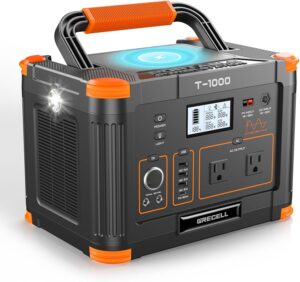

Can I run my coffee maker or microwave with this thing? If you’ve got a 1000W power station, it’s a natural question. These mid-sized “solar generators” can power a lot of household and camping gear, but they do have limits. Let’s break down what a 1000W (1 kW) portable power station will handle:
- Kitchen Appliances: A standard drip coffee maker typically uses 600-1000W. Good news – a 1000W station can brew your morning coffee. In fact, manufacturers often list coffee makers among supported devices. For example, Jackery notes their 1000W unit can run a coffee maker (about 600W) easily. Microwaves, however, are tougher. Even a “small” microwave might draw 1000-1200W of continuous power (a 700W cooking power microwave pulls around 1000W from the outlet). This is at or above the limit for a 1000W power station. If the microwave’s input exceeds your station’s inverter rating, it won’t run – the station will either shut off or trigger an overload. Bottom line: You can likely run a small microwave (rated ~700W output) for short bursts if your station has exactly 1000W output, but anything bigger is a no-go. Many 1000W stations actually advise against microwaves. It’s safer to use the microwave on a higher-power unit (or stick to stovetop heating when off-grid).
- Refrigerators: Surprising to some, a 1000W power station can run a household refrigerator – at least for a while. Fridges cycle on and off; their running draw is often 100-200W, which is easy work for a 1kW inverter. The challenge is the compressor’s startup surge – typically 5-6 times the running wattage. A fridge that runs at 150W might spike to ~750W at compressor startup. Most 1000W stations have 1500-2000W surge capacity, so they can handle that. Runtime is the other factor: a ~1000Wh battery can run a full-size fridge roughly 6-12 hours before draining (depending on how often the compressor runs). A small mini-fridge (60W) could run ~ 17 hours on a 1000Wh station (and about half that on a 500Wh unit). So yes, keeping your food cold through an outage is feasible. Just plan to manage energy (don’t open the fridge constantly, etc.).
- Home Electronics: Televisions, laptops, internet routers, game consoles – these are all well within a 1000W station’s ability. A typical LED TV might use 60-100W. Game consoles around 150W peak. You could set up an entertainment center in a blackout and be under 300W easily. Same for office devices: a laptop (~60W charging), a couple monitors, and Wi-Fi router might draw ~100W combined. A 1000W unit can run all that for hours. In one real scenario, a user ran a Wi-Fi router, laptop, and some lights on a Jackery 1000 during an outage and only used 20-30% of the battery over 5 hours.
- Power Tools: Here’s where you have to be careful. Many workshop tools like circular saws, drills, shop vacs, air compressors – can operate on ~800-1000W, but their startup surges often exceed 1000W. For instance, a medium circular saw might be 1200W running with a 1800W startup. That would likely overload a 1000W station (since surge is usually 2x max, around 2000W). Some smaller tools (a corded drill, Dremel tool, soldering iron) will be fine. But heavy-duty tools really call for a stronger power source. Jobsite tip: If you must use a tool near the limit, check if your power station has an “X-Boost” or similar feature (EcoFlow offers this) which can let the inverter handle slightly higher loads by dropping voltage – but use with caution. Generally, avoid high-draw power tools on a 1000W – you don’t want to trip your system or cause undue strain.
- Heating Appliances: Things like hair dryers, toasters, electric kettles, space heaters – these are notorious power hogs, often 1200W, 1500W or more. A 1000W station simply won’t run them at full power. For example, a hair dryer on “low” might be 800W (that could work), but on “high” it jumps to ~1500W – instant overload for a 1000W inverter. Same with most toasters and irons. Electric kettles are usually 1500W+, definitely out of range. In short, anything that uses heat via a heating coil is likely too much for a 1kW power station (unless specifically low-wattage travel versions).
- Miscellaneous: CPAP machines (the kind used for sleep apnea) are commonly around 30-60W. These are a piece of cake for a 1000W power station – and in fact, one of the best uses for having a battery backup. Many folks buy a unit specifically to run a CPAP through the night during camping or outages, and a 1000W is more than enough (it could run a 50W CPAP for roughly 16-20 hours on one charge). Fans and small cooling devices (like portable evaporative coolers) are also typically under 100W – no problem. Lights (especially LED lights) are very low draw; you could have a string of LED bulbs on for dozens of hours. For example, a 60W incandescent equivalent LED (which actually uses ~9W) could theoretically run for about 85+ hours on 1000Wh. So feel free to light up that campsite.
In summary, a 1000W portable power station can handle most small-to-medium appliances and electronics: from kitchen gadgets like blenders and coffee pots, to home electronics and medical devices. The don’ts are crucial: avoid anything above 1000W continuous draw – hair dryers, large microwaves, toasters, AC units, full-size heaters, and heavy power tools are generally off-limits. If in doubt, check the appliance’s wattage label. One user-friendly guideline: a 1000W station is great for “90% of home appliances” you’d use in an emergency or off-grid scenario – just not the big three (air conditioning, electric heating, high-power tools). Use your 1kW power wisely, and it will keep a surprising array of devices running smoothly.