

The lights flicker out on a stormy night – but you confidently reach for a portable power box by your side. In seconds, your Wi-Fi, a lamp, and even the TV are back on, running off this silent battery pack. Portable power stations are becoming household heroes, and it’s no wonder: 84% of Americans worry about power outages. A 1000W portable power station hits a sweet spot – it’s beefy enough to run most small appliances and keep your gadgets charged, yet still compact enough to take camping or stash in a closet for emergencies. In fact, the global market for these handy power hubs is surging (valued at $603 million in 2024 and projected to nearly double by 2032) as people seek reliable backup energy at home and off-grid. Whether you want to brew coffee during a blackout or keep your laptop and phone going on a weekend camping trip, a 1000W power station can be your lifeline. Let’s explore some of the best 1000W portable powerhouses out there, blending ample wattage with portability, and see which one might fit your needs.
| Product Name | Image | Check Amazon Price and Reviews |
|---|---|---|
| Jackery Explorer 1000 |  | |
| Geneverse HomePower ONE |  | |
| Goal Zero Yeti 1000X |  | |
| BLUETTI EB150 |  | |
| EF EcoFlow Delta 1300 | 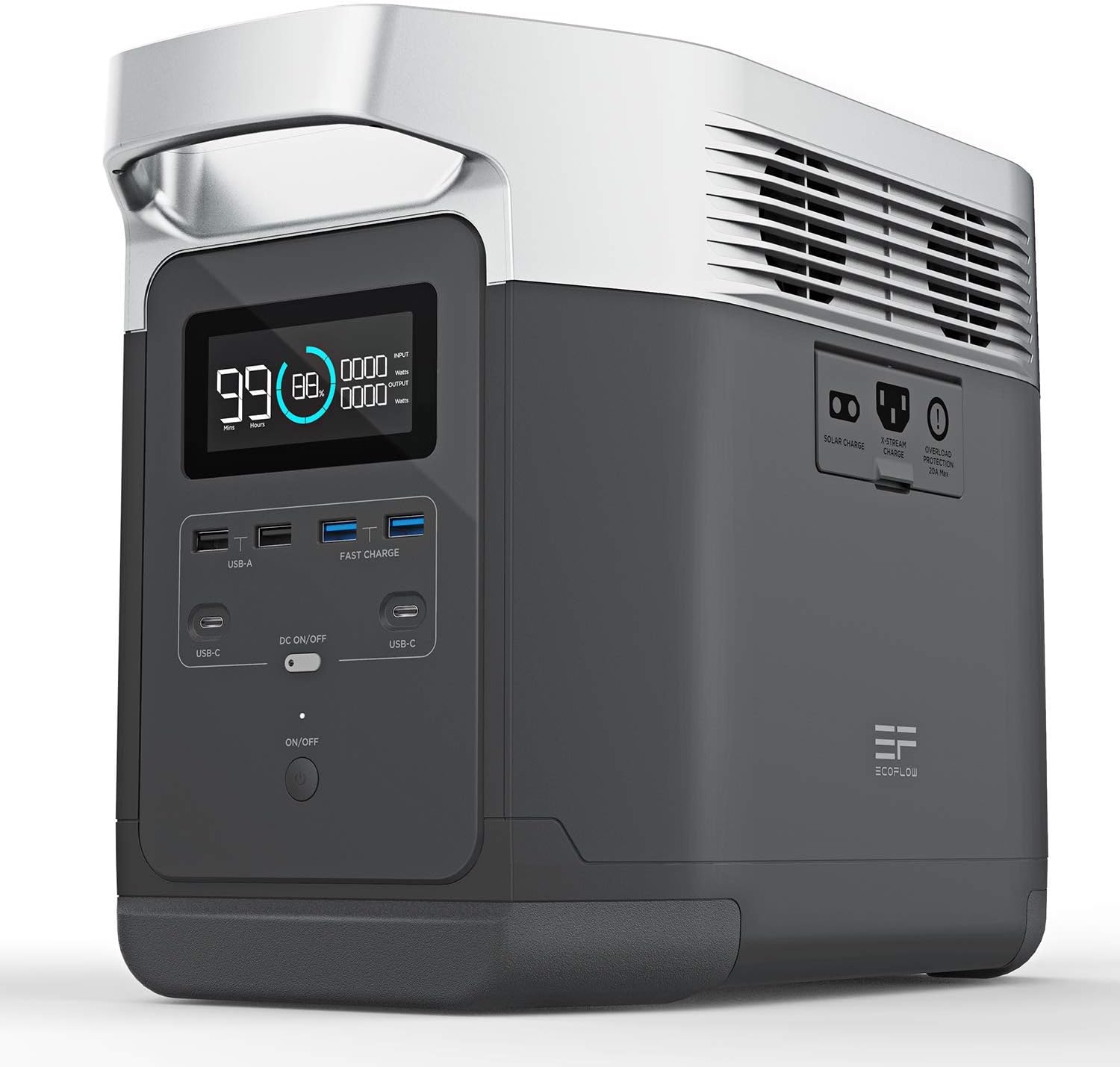 | |
| ALLPOWERS R1500 |  |
Contents
Jackery Explorer 1000


Key specs at a glance:
– Battery: 1002Wh (Li-ion NMC), ~7 hours recharge via wall charger
– Output: 1000W AC (2000W peak) – powers devices like mini-fridges, TVs, fans
– Weight: ~22 lbs (10 kg) – fairly portable
– Ports: 3 AC outlets, 2× USB-A, 2× USB-C, 12V car port (runs/charges 7+ gadgets at once)
– Notable: Built-in LCD shows input/output and battery %. Solar-ready (supports panels, not included).
One of the most popular names in the game, the Jackery Explorer 1000 is like the “golden retriever” of portable power stations: friendly, reliable, and widely loved. This unit offers a 1002Wh lithium battery and a pure sine wave inverter that delivers 1000W continuous output (2000W surge) – enough to run a small fridge, charge laptops and phones, or even make coffee on a drip coffee maker. Weighing about 22 lbs, it’s reasonably easy to haul around. The Explorer 1000 features a sturdy build with a big carry handle on top. It comes with multiple ports (three AC outlets, two USB-C, two USB-A, and a 12V car port) so you can charge or power up to 7 devices at once. This is a classic choice for campers, RVers, and homeowners preparing for outages – a well-rounded unit that’s earned its trustworthy reputation over the years.
Geneverse HomePower ONE

What you should know:
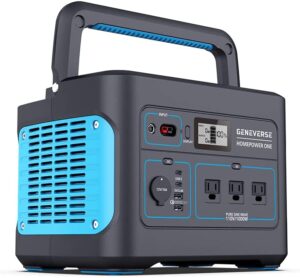
– Capacity & Power: 1002Wh battery, 1000W output (2000W peak) – plenty for fridges, CPAPs, lights, etc.
– Outputs: 3 AC outlets (110V), 2× USB-C (PD 18W), 2× USB-A, 1× 12V car – runs multiple devices simultaneously
– Design: Sturdy and compact (13×9×9.6 inches), with a lay-flat handle for easy storage
– Weight: ~23 lbs – still portable for most adults
– Perks: Can recharge via AC, 12V car, or solar (built-in MPPT). Emphasized for emergency prep (long shelf life, includes car and solar charging cables).
Formerly known as Generark, the Geneverse HomePower ONE is a solid 1000W contender geared toward emergency backup. It packs a 1002Wh lithium-ion battery (similar capacity to the Jackery) and outputs 1000W continuous (2000W surge) across three AC outlets. What sets the HomePower ONE apart is its focus on home readiness – Geneverse markets it as providing “up to 7 days of essential power” on a single charge (of course, that depends on what you’re running). Weighing about 23 lbs, it’s still luggable with a built-in handle and a compact frame. This unit sports 8 total ports (3 AC, 2 USB-C, 2 USB-A, 1 car socket), giving you plenty of options to plug in devices. In real-world use, owners have powered things like CPAP machines, Wi-Fi routers, lamps, and fridge/freezers under 1000W – basically keeping critical devices running comfortably. If you want a home backup battery that’s simple, safe, and holds a charge for the long haul (Geneverse advertises up to one year of standby charge retention), the HomePower ONE is a dependable choice.
Goal Zero Yeti 1000X

Standout features:
– High Output: 1500W AC inverter (3000W surge) – handles appliances like refrigerators, TVs, lights, power tools that other 1000W units may not.
– Battery: 983Wh (Li-ion NMC). Goal Zero’s battery management allows chaining to their tank modules for more capacity.
– Ports: 7 ports (2× AC, 2× USB-A, 2× USB-C PD 60W, 12V car, plus 6mm 12V outputs) – a bit fewer AC outlets than some rivals, but enough for essential devices.
– Display & Build: Clear LCD shows input/output watts and battery %. Sturdy metal enclosure built to endure outdoor use and frequent transport.
– Use Case: Ideal for home backup – can run tablets, laptops, medical devices like CPAP, even a full-size fridge in emergencies. Also great on worksites for drills, saws (up to 1500W) or in RVs. It’s a hefty 31.7 lbs unit, so Goal Zero added a top carrying handle on each side for two-handed lifting.
Goal Zero’s Yeti series is a veteran in the portable power world, known for robust build and versatile performance. The Yeti 1000X is the modern update to their 1000 lineup, offering a 983Wh battery and a beefier 1500W inverter (3000W surge) – noticeably higher output overhead than typical 1000W units. This means the Yeti can tackle hungrier appliances (it’s rated to handle things like full-size refrigerators, power tools, or a small microwave in short stints) that other 1000W stations might trip on. With that capability comes a bit of extra heft: the Yeti 1000X weighs about 31.7 lbs, so it’s on the heavier side – not something you’d backpack with, but still “portable” in the sense of moving it around the house or into a vehicle. Users appreciate the Yeti’s rugged metal casing and informative display. It’s also expandable (compatible with Goal Zero’s Expansion Module and external lead-acid batteries if you ever wanted to increase capacity). The Yeti 1000X shines for home backup use – for instance, it can run a fridge for roughly 14-24 hours (depending on fridge size) or keep power tools running on a job site, thanks to that 1500W continuous output. This is a “heavy-duty” 1kW station for those who don’t mind a bit of weight in exchange for extra power headroom.
BLUETTI EB150

Highlights:
– Capacity King: 1500Wh battery – provides significantly longer run times (e.g. can run a 300W blender ~2.8 hours vs ~1.8 hours on a 1000Wh unit). Ideal for extended outages or off-grid living.
– Power Output: 1000W continuous (1200W surge) – safe for devices under 1000W. Not meant for heavy surges, but fine for appliances like TVs, mini-fridge, projector, etc.
– Weight & Size: ~38 lbs; larger and heavier – you’ll feel the weight, but it’s the trade-off for extra juice. Best moved by car or cart rather than by hand for long distances.
– Connections: 2 × AC outlets, 1 × 12V car port (regulated 10A), 4 × USB-A, 1 × USB-C (45W). Lacks some modern fast USB-C, reflecting its age, but covers basic needs.
– Charging: Supports up to 500W solar input (MPPT) or standard AC. Charging from 0-100% takes ~8 hours via wall. Note: Uses older Li-ion chemistry (around 500 cycle lifespan to 80% capacity), so to prolong its life, avoid deep discharges each use.
If runtime is a priority, the BLUETTI EB150 offers a larger reservoir of energy while still fitting in the 1000W output class. The EB150 holds a whopping 1500Wh battery (hence the model name) paired with a 1000W pure sine inverter (1200W surge). In practice, that means you get roughly 50% more battery life than a 1000Wh unit – very handy for multi-day off-grid trips or longer emergency backup. Of course, more capacity adds some weight: the EB150 weighs around 37-38 lbs (about as much as a medium suitcase). It’s not a unit you’d casually carry on a hike, but it has a sturdy top handle for lugging short distances. The form factor is a bit bulkier than others on this list – essentially a big blue lunchbox looking device – but it’s built solid. With two AC outlets, a regulated 12V car port, and multiple USB ports, the EB150 can power a small campsite or serve as a UPS alternative at home. For example, this could run a 60W mini fridge for roughly 20-24 hours on a single charge, or charge smartphones over 100 times. BLUETTI is known for using high-quality battery cells and including an advanced battery management system. The EB150 is an older model in their lineup, but it remains popular for its massive capacity per dollar. It’s a great pick if you want extended power autonomy in the 1000W range.
EF EcoFlow Delta 1300
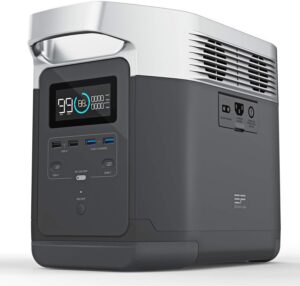

Notable features:
– Extra High Output: 1800W continuous, 3300W surge – can even run many microwave ovens or power tools that demand >1000W (for short durations). Essentially future-proofs you for heavier loads.
– Battery: 1260Wh lithium (NCM). Slightly above 1kWh, giving a bit more runtime than typical 1000Wh units.
– Rapid Recharge: Charges 0-80% in ~50 minutes via AC (full in ~80 min) thanks to X-Stream fast charging. Also accepts solar charging (up to 400W) – roughly 4-6 hours in good sun for full charge.
– Outputs: 6 AC outlets (pure sine), 4 USB-A, 2 USB-C (60W), 12V car port. Can power up to 13 devices at once.
– Portability: 30.9 lbs, with two side handles for lifting. It’s a dense unit but still manageable for most people to move around as needed.
This is the unit that turned a lot of heads toward lithium power stations a couple years ago. The EcoFlow Delta (sometimes called Delta 1300) offers 1260Wh of capacity and a powerful 1800W inverter (3300W surge), punching well above the “1000W” label while still being in the ~1kWh battery class. Why include it here? Because the Delta’s capabilities make it a direct competitor to the 1kW stations – and if you need extra oomph (say, to run a microwave or toaster), it’s up to the task. The trade-off: it’s a bit pricier, and at 30.9 lbs it’s not much heavier than some less capable units. The Delta is famous for its ultra-fast charging – plug it into the wall and it can go from 0% to 80% in about 50 minutes, which is insanely fast (most others take 5-8 hours). This speed, along with a robust build, makes the Delta great for both emergency use and frequent daily use. It has six AC outlets, so you can power many appliances at once (total up to 1800W). During a blackout, you could run your fridge, some lights, a router, and still have room to charge phones – the Delta can handle it. It also supports up to 400W of solar input for off-grid charging. Overall, the EcoFlow Delta blurs the line between “1kW” and “2kW” categories, offering a taste of higher power in a reasonably portable package. If you anticipate needing to power multiple high-wattage devices simultaneously, the Delta is a compelling choice.
ALLPOWERS R1500
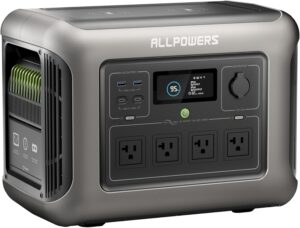

In a nutshell:
– Capacity & Power: 1092Wh Li-ion battery, with 1600W pure sine wave output (supports surges to 3000W). Packs more punch than standard 1000W units – great for high-watt appliances.
– Recharging: Fast AC charging (≈1.5 hours to full on wall outlet). Solar input up to 500W for quicker solar charging as well.
– Outputs: 4 AC outlets, 2 USB-C (100W PD fast charge), 2 USB-A, 1 car port, plus two 15W wireless charging pads on top – very handy for Qi-enabled phones.
– Design: Modern and robust, with cooling fans to sustain higher loads. The informative display shows battery status and output load. Built-in LED light for camp/night use.
– Value: Delivers a lot of watts per dollar. Ideal if you need affordable high wattage – for example, it can run a coffee maker (~600-1000W) and a microwave (~700W) separately, which many lower-cost stations can’t. Slightly less proven brand, but specs and user feedback inspire confidence.
If you’re looking for a budget-friendly 1000W station that doesn’t skimp on key specs, the ALLPOWERS R1500 is worth a look. This unit provides 1092Wh of capacity and a 1500W inverter (1600W peak), which is quite generous on the wattage side for its price range. It’s a great option for those who want a high output without paying premium brand prices. The R1500 can comfortably run things like an electric grill, blender, or small heater (under 1500W) – tasks that would max out a 1000W unit. It has a sturdy build with an LCD screen and even features like wireless charging pads on top for phones. Weighing in around 30 lbs (13.6 kg), it’s relatively portable, complete with a handle. ALLPOWERS includes multiple charging options and claims fast recharging (about 1.5 hours from AC, thanks to a 1000W AC input). This station hasn’t been around as long as Jackery or Goal Zero in the U.S., but user reviews are positive, citing the huge power output for the size and solid performance running mini-fridges, power tools, and electronics. It’s an ideal “value” pick: high wattage and capacity at a lower cost-per-Wh.