

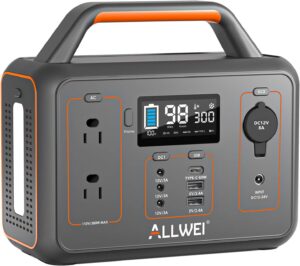

You’ve been getting by with a little USB power bank to charge your phone, but now you’re eyeing a portable power station. Is it time to upgrade? What benefits will a power station give you, and in what situations does making the jump make sense? In this article, we’ll explore when and why you might upgrade from a small power bank to a portable power station, highlighting the differences in capability and use cases. Essentially, it comes down to needing more power, more ports, and AC capability – we’ll break that down for you in practical terms.
Contents
Understanding the Difference
First, let’s clarify terms: – Power Bank: Usually a pocket-sized battery with USB outputs to charge phones, tablets, etc. Typically 5,000mAh to 20,000mAh (roughly 18-74Wh) for common ones. No AC outlet, no high-voltage output. Strictly for USB/low DC devices. – Portable Power Station: A larger device (often shoebox-size or so) with a battery measured in tens or hundreds of watt-hours (100Wh up to several thousand Wh). Crucially, it has an AC inverter giving you standard wall-style plugs, plus multiple DC outputs (USB, 12V car socket, etc.). It’s basically a small generator alternative (some call them “solar generators”).
So, it’s like comparing a water bottle (power bank) to a water cooler (power station).
When Does Upgrading Make Sense?
- When You Need to Power Devices Beyond USB Gadgets. This is the big one. If you find yourself wishing you could run or charge something that plugs into a wall – like a laptop that doesn’t support USB-C charging, a fan, a small appliance, camera battery charger, etc. – a power bank just won’t cut it. Portable power stations have AC outlets so you can run those devices. For example, camping with just a power bank limits you to phones and maybe a USB light. With a power station, you could run a CPAP machine, keep a mini-fridge or cooler running, or use a projector for movie night, etc.
If you’re facing a power outage, a power bank keeps phones alive, but a power station can keep critical appliances (router, radio, even medical devices) running for a while. So if your preparedness needs have grown, it’s time to upgrade.
- When You Need More Capacity (More Watt-Hours). Maybe earlier you only needed to top up your phone once or twice on a trip, and a 10,000mAh bank was fine. But now you have multiple gadgets – phone, tablet, Bluetooth speaker, maybe a drone – and/or you go on longer trips without outlets. A small power bank might fizzle out day 2. Portable power stations often start around 150Wh and up, which is 3-5 times more capacity than a typical small bank. That could charge phones for a week or keep multiple devices going.
So if you find yourself rationing your little power bank or constantly recharging it, a station provides a much larger energy reservoir.
- When You’re Doing Car Camping, RVing, or Off-Grid Work. In a car or RV, you could rely on the vehicle battery (using a 12V socket, etc.), but that can risk your car battery or requires running the engine. A power station lets you have a separate source that’s designed for deep discharge. For off-grid cabins or sheds, you might want to run DC lights or tools – a power station is basically a plug-and-play solar system (especially if you add a panel).
Say you start doing remote photography work – charging camera batteries, maybe running a laptop or a monitor on-site. A power station becomes a portable outlet hub. A power bank would conk out or simply can’t plug half those things in.
- When You Want Solar Charging Capabilities. Most power banks don’t support direct solar input (though there are small solar banks, they are often gimmicky or very slow). Portable stations typically have solar charge ports and MPPT controllers. If you want to utilize solar energy – e.g., camping for a week and recharge via solar panel in the day – you need a power station. That’s a compelling upgrade if you are venturing into sustainable off-grid power usage.
- Emergency Home Backup. If you’ve ever had a blackout that lasted more than a few hours, you know a phone power bank feels pretty limited. Upgrading lets you run a lamp, keep a fan going, charge multiple phones, maybe keep the internet on via the router. It’s a comfort and safety thing. Many people upgrade after experiencing a multi-day outage; a power station becomes part of their emergency kit, far more useful than a pocket power bank in such scenarios.
Why Not Just Get a Bigger Power Bank?
You might consider something like a 26800mAh USB-C bank (which is around 100Wh) as a step-up. These are great if your only need is more USB juice. But they still can’t do AC output. So the question is: do you foresee needing AC or 12V outputs? If yes, only a power station will do. Plus, power stations often include those high-power USB-C ports too, so you get the best of both worlds (some power stations basically incorporate a power bank within them for USB outputs, but also add AC).
Additionally, bigger power banks near 100Wh are getting into airline limit territory – above ~160Wh you can’t easily fly with anyway. So if it’s too big, it’s essentially a power station without AC. Might as well get AC too if you’re going large (keeping in mind portable stations usually not allowed on planes once over 160Wh, same as big banks – under that, some small ones like ~146Wh may be allowed with approval).
Consider Size and Weight
Upgrading does mean more bulk. A 20,000mAh bank fits in a pocket; a 300Wh power station weighs ~10 pounds and size of a small cooler. So if you only do ultralight hiking – no, you don’t want that. But if portability to you means car portability or carrying from car to campsite, that size is fine. Just consider how you’ll transport it. Many come with handles for easy carry. If you actually need something still backpack-sized but a bit more oomph, there are intermediate devices (like 100Wh AC power banks – borderline power station). But generally, expect trade-off: power vs. portability.
Upgrade when your power needs outgrow the convenience of a pocket-size device. If you find yourself carrying multiple power banks or one that’s always tethered to a small inverter perhaps – time to consolidate into a proper power station.
Cost Factor
Power stations under $200 can give you around 200Wh and AC. If you were thinking of buying two high-end USB-C power banks at $70 each (for capacity), that’s $140 and still no AC. For a bit more, you can get a 240Wh Jackery or similar. So financially, if you need that much capacity, a power station is often more cost-effective per Wh and adds functionality.
When not to upgrade yet: If you rarely need extra power, or only need to charge phone/tablet on the go, a power station might be overkill. Stick with the light power bank until your lifestyle demands more. Also, power banks are allowed on planes easily (under 100Wh no question), whereas power stations often are not due to size. So for frequent air travel, keep using banks.
Summing Up – The Why
- Versatility: A key reason to upgrade is simply being able to power a wider range of devices. You go from just USB things to potentially anything up to, say, 300W – which covers fans, mini TVs, some tools, small appliances. That opens possibilities for comfort (fans, lights), productivity (laptops, monitors), and safety (medical devices, radios) off-grid.
- Capacity: You might upgrade because you’re tired of a dead phone or laptop after day 1 of camping. A station ensures all your gadgets can last entire trips with power to spare.
- Preparedness: As personal backup plans become more important (with more people working from home, etc.), having a power station is like having an insurance policy for small electronics, whereas a power bank is a very limited form of that insurance.
If one or more of these reasons resonates – e.g., you have an off-grid hobby, you’re prepping for emergencies, your device count has grown, or you just want the convenience of an “outlet anywhere” – then upgrading to a portable power station is likely worth it. You’ll appreciate the independence that comes with having your own little power source ready to go, anywhere, anytime, far beyond what a small power bank could offer.