


If you’re torn between a 1000W and a 2000W portable power station, you’re essentially deciding how much muscle your backup power should have. It’s a bit like choosing between a half-ton pickup and a full-ton truck – both carry a load, but one handles the really heavy stuff with ease. So, do you need that extra power? Let’s compare scenarios to help you decide.
Running Heavy Appliances: The biggest reason to opt for a 2000W unit is if you plan to power high-wattage devices or multiple appliances at once. A 1000W station covers a lot (lights, small fridge, TV, laptop, etc.), but it cannot run things like microwave ovens, toasters, space heaters, or larger power tools which often draw well over 1000W. With a 2000W power station, suddenly those become fair game. For example, a standard microwave (~1200W) can run on a 2000W unit (since it has headroom up to 2000W), whereas a 1000W unit would overload. Planning to boil water with an electric kettle (1500W) or use a hair dryer (1400W)? That’s only feasible with ~2kW of output. Similarly, on job sites or DIY projects, a circular saw or mitre saw that draws 1500-1800W will run smoothly on a 2000W station but would trip a 1000W every time. In short, if your use-case includes any single device above ~1000W or multiple devices whose combined draw exceeds ~1000W, you should lean toward a 2000W model.
Home Backup – Number of Devices: Think about what you want to run during an outage. A 1000W station might run your fridge and some lights, but not much else simultaneously. A 2000W station could run a fridge (around 150-200W when compressor is on), a chest freezer (another ~150W), some lights, and charge phones – all at the same time – and still be under its wattage limit. It can also better handle surge loads when, say, both the fridge and freezer compressors kick in together (the combined surge could be ~1200-1500W, which a 2000W can absorb with ease). Essentially, a 2000W gives you more breathing room to keep multiple household appliances running. In an emergency, that could mean running an oxygen concentrator or medical device while also keeping food cold and a room heater/fan going. If you have critical or comfort devices that total above 1000W in combined usage, the bigger unit is worth it.
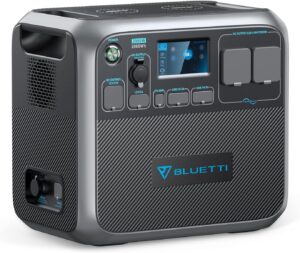
Portability & Weight Trade-off: Here’s a non-electrical factor: weight and size. A 2000W power station is usually much bulkier and heavier than a 1000W. We’re talking on the order of 40-60+ pounds (18-27 kg) for 2kW units, versus 20-30 lbs for 1kW units. That’s a big difference in portability. For example, the Bluetti AC200P (2000Wh, 2000W) weighs about 60 lbs – portable technically, but you won’t enjoy moving it around too often. One reviewer noted that at 60 lbs, you’ll likely station it in one place and not want to relocate it frequently. In contrast, a Jackery Explorer 1000 is ~22 lbs, very grab-and-go. Some newer 2000W models are trying to bridge this gap – the Jackery 2000 Pro comes in around 43 lbs, and they market it as 34% smaller and 41% lighter than traditional 2kWh stations. Also, many 2000W units include wheels or telescoping handles (think luggage-style) to help move them, precisely because they know ~50+ lbs is not fun to carry. So ask yourself: Will you need to carry your power station on foot long distances or often? If yes, a 1000W might be more practical. If the station will mostly stay in your vehicle or at a home base, the weight of a 2000W is manageable (especially with wheels).
Battery Capacity Considerations: Hand in hand with higher output usually comes higher capacity (watt-hours). 2000W portable stations almost always have around 2000Wh (2 kWh) or more battery capacity, whereas 1000W stations are ~1000Wh. This means double the energy storage. So beyond just power, a larger unit can run stuff longer. For instance, if a 1000Wh battery runs a fridge for 10 hours, a 2000Wh can run it for ~20 hours. This can be as important as wattage for backup scenarios. If you’re preparing for multi-day outages, the extra capacity of a 2kW/2kWh unit is a big plus (though you could also achieve that by pairing a couple of 1kW units or extra battery packs in some systems).
Use Case Examples: – Camping/Vanlife: Many van dwellers find 1000W units sufficient for basic living (lights, vent fan, charging devices, maybe running a small blender). But if you have a van with a mini microwave or induction cooktop, a 2000W is nearly mandatory to handle the cooking appliance. Also, some air fryer or electric cookers for camping draw ~1500W – again, only feasible with a 2kW. If your idea of camping is more “glamping” with kitchen gadgets, go 2000W. If it’s just keeping the essentials (fridge, lights, electronics), 1000W does the job and saves weight. – Home emergency backup: If you just want to keep a few essentials running (fridge, some lights, router), a 1000W station actually covers that – 31% of Americans said they just want to avoid “inconvenience” during blackouts (like keeping food fresh and staying online), which a 1kW can do. But if you’re among those with bigger needs – say you have a sump pump (often ~1000W draw) and you want to run that and some other device simultaneously, or you have medical equipment plus appliances – lean 2000W. Notably, families with someone on an electric medical device (oxygen concentrator, etc.) often opt for larger units to ensure plenty of capacity and the ability to plug in additional items without overload. – Solar Integration: If you plan to recharge via solar, note that larger stations usually accept higher solar input (e.g. 2000W unit might take 400-800W solar, whereas 1000W unit might max at 200-300W). This means a 2000W system can recharge faster with a big solar array. If you’re building a serious off-grid solar setup, the bigger unit has an advantage. However, for occasional use with a couple panels, a 1kW unit might be enough and easier to move to the sun.
Cost: Generally, 2000W units cost significantly more than 1000W (often nearly double the price). You’re paying for the larger inverter and bigger battery. If budget is a concern and you don’t explicitly need the higher output, it might be more economical to get a 1000W station. Some folks solve the dilemma by getting two 1000W stations – using one for certain devices and one for others, which also adds redundancy. But if you truly need to power a single large appliance, two smaller units won’t help – you need one big inverter.
Middle Grounds: It’s worth mentioning that there are “in-between” models (around 1500W output) which might hit a sweet spot if you can’t decide. Also, some newer power stations allow linking two units together for double output (EcoFlow and Bluetti have such options) – though that often requires buying identical units and a special coupling kit, which is a costly route.
Verdict: Choose 1000W if you want a lighter, more portable power station for general use – camping, small appliance backup, and you don’t plan to run anything above a kilowatt. Choose 2000W if you have specific high-wattage needs or just want more flexibility and capacity for an extended outage or off-grid living. In many cases, the extra power is a game-changer: for example, being able to run a heater or microwave can turn a cold, dark outage into a minor inconvenience instead of a major discomfort. One survey found 59% of people would prioritize buying a portable power station after experiencing frequent outages – if you’re in that boat and can afford it, going for the larger unit can offer more peace of mind. Remember, with great power (station) comes great responsibility – and by that we mostly mean it comes with wheels or a strong friend to help you move it!