

Sun, sea, and…solar panels? When you’re out on a boat, whether it’s a sailboat, fishing skiff, or cabin cruiser, having reliable power makes all the difference. Portable power stations can run your cooler, charge trolling motor batteries, or keep your electronics and navigation gear powered without running the engine or generator. But marine environments are harsh – think salt, spray, and constant movement. We’ve compiled a list of the best portable power stations for boating & marine use, focusing on units that are robust, safe, and boat-friendly.
| Product Name | Image | Check Amazon Price and Reviews |
|---|---|---|
| BLUETTI AC200P Portable Power Station |  | |
| EcoFlow DELTA 2 Portable Power Station |  | |
| Jackery Explorer 1000 Pro Portable Power Station |  | |
| Goal Zero Yeti 1000X Portable Power Station |  | |
| Anker 757 PowerHouse |  |
Contents
BLUETTI AC200P Portable Power Station (2000Wh, 2000W)


Marine merits:
- High Surge Capacity: 4800W surge handles startup of devices like fridge compressors or water pumps easily.
- LiFePO4 Safety: Peace of mind in closed quarters – no toxic off-gassing, greatly reduced fire risk compared to older lithium chemistries.
- Heavy-Duty Build: Sturdy casing can endure a humid, salt-air environment (just keep it dry from direct splashes).
- Expandable via Battery Packs: For long voyages, you can add extra BLUETTI batteries to boost capacity (if you have the room).
- Multiple Outlets: 6 AC plugs mean you can power several things in different parts of the boat at once (galley, cabin, cockpit lighting via extension, etc.).
The BLUETTI AC200P is a beast of a power station that has proven itself in off-grid and marine scenarios. With 2000Wh capacity and a 2000W pure sine wave inverter, this can handle most onboard appliances short of air conditioning or stovetops. Want to run a small 12V fridge/freezer, some cabin lights, and charge everyone’s devices? No problem. It even has a built-in 25A DC output specifically useful for RV or boat circuits. Its LiFePO4 battery chemistry is a big plus on a boat – these batteries are inherently safer and more stable (no risk of thermal runaway fire) and handle the bumps and movement well. The AC200P’s design is durable and somewhat water-resistant: while not fully waterproof, it has a tough exterior with few exposed ports that could let spray in. Many liveaboard sailors like that they can hook up significant solar (up to 700W) to this unit – great if your boat has solar panels on deck or bimini. It also can be charged via the yacht’s alternator (with an appropriate DC-DC charger). One more neat feature: dual wireless charging pads on top – drop your phone there while cruising and keep it topped up. If you need serious power afloat, the BLUETTI AC200P stands out as a marine powerhouse.
Find it on Amazon: https://www.amazon.com/dp/B08MZJW9Y5/?tag=celebography-20
EcoFlow DELTA 2 Portable Power Station (1024Wh, 1800W)
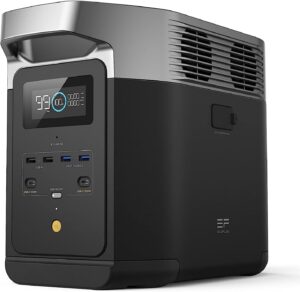

Key perks:
- Rapid Dockside Charge: Full charge in ~80 minutes means you can juice up during a brief pit stop at port.
- Shore Power Bypass: If you keep it plugged in on shore power, it can function like a UPS, powering AC devices on your boat continuously and seamlessly switching if shore power fails or is disconnected.
- Compact Form: Easy to stow in a locker or under a seat.
- Solar Charging: Supports ~500W solar input, great if you’ve got marine solar panels – you can harvest the sun while at anchor quietly.
- AC and DC flexibility: With 6 AC outlets and regulated 12V output, it can run both household-type appliances and direct 12V marine electronics (like a fish finder or VHF radio) simultaneously.
The EcoFlow DELTA 2 is a mid-sized unit packed with features that boaters will appreciate. At ~1024Wh, it’s enough to run smaller appliances and gadgets through a day trip or weekend, and the 1800W output means it can even handle high-draw devices like a blender for your sunset margaritas. One of the DELTA 2’s killer features is its fast charging – from AC it can go 0-80% in about 50 minutes. Why is that great for boating? If you’re at a marina or dock with shore power, you can rapidly recharge the station before heading back out. Also, it charges quickly from solar and 12V, so if you have limited generator run time or sun windows, it’s very efficient. For marine use, the DELTA 2’s casing is solid with no fans on the sides, so you can tuck it in a cabin corner without worry of spray ingress (still, not waterproof – you’ll want to shield it from direct water). It has an app for monitoring, which could be handy on a boat to check status from your phone without going below deck. The LiFePO4 battery gives it a long cycle life, meaning it will last for many seasons of boating. At about 27 lbs, it’s portable enough to move on and off the boat if you want to use it elsewhere. Overall, the EcoFlow DELTA 2 combines speed, power, and smart tech – a versatile choice for marine adventures.
Jackery Explorer 1000 Pro Portable Power Station (1002Wh, 1000W)


Highlights:
- Marine Durability: While not waterproof, these units have been known to handle the marine environment well – keep it in a dry spot and occasional salt air won’t faze it.
- LED Light: It includes a built-in LED flashlight; could be handy on deck at night or in an emergency.
- Charge Cycle Life: Rated for ~1000 cycles to 80% – enough for many years of weekend boating use.
- SolarSaga Synergy: If you use Jackery’s SolarSaga panels, the integration is plug-and-play. Two 100W panels can recharge it in around 8 hours of sun.
- Multiple Outputs: 3 AC outlets (pure sine) for appliances, plus USB-C PD 100W which is great for directly charging newer fishfinder tablets or drones without needing AC.
Jackery’s Explorer series is popular everywhere, and the 1000 Pro model brings some improvements that boaters will love. It’s a bit lighter and more compact than its predecessor, making it easier to carry aboard. With 1002Wh capacity and 1000W continuous output (2000W surge), it’s perfectly suited for typical marine uses: running a small electric cooler, charging handheld marine radios, powering a laptop at the nav station, or even running a low-wattage 12V bait aerator or fish-finder for many hours. One huge advantage for marine use is Jackery’s reliability and simplicity – it’s very much a “it just works” unit with a straightforward interface, which is good when bouncing on waves and you don’t want to fiddle with settings. The Explorer 1000 Pro can charge via solar (up to about 200W) and 12V car outlet – and it’s relatively quick on AC (about 1.8 hours to full on wall plug). Many boaters pair a Jackery with a foldable solar suitcase panel on deck when moored to keep it topped up. An underrated feature: it’s quiet – the fans only run when necessary and even then softly. So if you have it in a cabin berth, it won’t disturb a peaceful evening. If you’re looking for a well-rounded, proven power station for your boat, the Jackery Explorer 1000 Pro is a safe bet.
Goal Zero Yeti 1000X Portable Power Station (983Wh, 1500W)


What stands out:
- High Output Inverter: 1500W continuous can handle more than typical “portable” units – gives you confidence running heavier draw items if needed.
- Charging Options: Can charge from 12V, solar (up to ~600W with MPPT), or AC. With the right cables, you can hook to alternator or even a wind turbine for sailboats.
- App Monitoring: Goal Zero Yeti app allows remote monitoring of input/output – helpful on a boat to check power status from the helm.
- Pass-Through Charging: It can charge and discharge at the same time, so you can use it as a power hub when shore power is available (acts like a UPS).
- Regulated 12V Outputs: Good for sensitive 12V electronics – the voltage stays stable which is important for marine devices.
Goal Zero has a strong pedigree in expedition power, and the Yeti 1000X is a unit that many sailors and boaters trust. Just shy of 1000Wh, it provides plenty of juice, and its inverter is rated at 1500W (with 3000W surge) – significantly higher headroom than most in this class. That means on a boat you could potentially run a microwave or electric cooktop for short periods (if you must), or a power tool for boat maintenance, which smaller units can’t handle. The Yeti 1000X uses a Lithium NMC battery, which is high energy density and kept in check by Goal Zero’s advanced battery management. One marine-friendly feature: the Yeti can integrate with the Yeti Link and Tank system – meaning if you have an existing 12V battery on board, you can tie the Yeti into that system as a UPS or additional storage. Also, Goal Zero makes a Vehicle Integration Kit that some use on boats to charge the Yeti from the engine’s alternator more efficiently. In terms of construction, the Yeti has a robust metal enclosure with rubber corners – it’s built tough, which is good on a boat that might rock or have gear shifting around. It’s not the lightest (around 40 lbs), but it packs a serious punch. If you want a hybrid solution that can be both portable and semi-integrated into a boat’s electrical setup, the Yeti 1000X offers a lot of flexibility and trusted performance.
Anker 757 PowerHouse (1229Wh, 1500W)


Marine features:
- LiFePO4 Stability: Safe for indoor cabin use and less stress about thermal issues in a moving, unattended environment.
- High AC & DC Output: 1500W AC plus plenty of DC options (cigarette port and USB) means one unit can run the show.
- LED Lighting Panel: Has an integrated LED light bar on the back – could be useful on deck at night or during emergencies to illuminate your work area.
- Expandable? Not in the sense of adding extra batteries like some others, but you can always add another 757 in parallel for more capacity – just distribute loads.
- Quiet Cooling: Fan noise is minimal and only ramps up if you really push the output – in normal use it shouldn’t disturb the tranquility of your anchorage.
The Anker 757 PowerHouse is a relatively new contender that has quickly gained respect for its build quality and performance. For marine use, there’s a lot to like: it has a LiFePO4 battery (which, as mentioned, is great for safety and longevity), a 1229Wh capacity, and a 1500W inverter – so it’s comparable in power to the Yeti above, but using the newer battery tech. Anker put effort into making this unit durable; it has a solid frame, and the internal components are arranged to dissipate heat efficiently – handy in a hot engine room or sunny deck. It weighs around 43 lbs, but comes with two very sturdy handles for lifting aboard. The 757 can fast-charge from AC (about 1.5 hours to full), and supports up to 300W solar input. Unique among many, it also features dual 100W USB-C ports. For a boat, that means you can directly power/charge two USB-C devices (like a laptop and a tablet) at high speed without needing AC adapters – simplifying your power needs on board. The display on the 757 is very clear, showing time-to-empty or full, which is nice when you’re managing power closely on multi-day trips. Considering its high cycle life (3000 cycles) and 5-year warranty, it’s a unit designed for the long haul, literally and figuratively – making it a great investment for regular boaters.