

Boaters have long relied on traditional marine batteries (deep-cycle, AGM, etc.) to power their on-board electronics and accessories. But now portable power stations (essentially big lithium battery packs with built-in outputs) are presenting a tempting alternative. So, if you’re outfitting your boat, you might wonder: Should I stick with a marine battery or use a portable power station? Let’s weigh the differences in context:
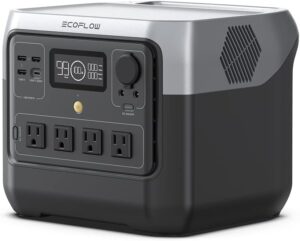

Form Factor and Installation: A marine deep-cycle battery is usually a heavy brick (often 50+ lbs), and you’ll need to wire it into your boat’s electrical system with proper terminals, fuses, and possibly an inverter if you want AC power. It’s typically a semi-permanent install – possibly in a battery box or compartment. A portable power station, on the other hand, is self-contained: it’s battery + inverter + outlets all in one, often with handles and relatively easier to move (though a 1000Wh unit can still weigh ~20 lbs). If you don’t want to modify your boat or run wiring, a portable station is plug-and-play – just bring it aboard and you have power. If your boat already has a house battery setup, adding another marine battery might integrate more seamlessly though (just parallel or use a switch).
Power and Capacity: Marine batteries come in various capacities (measured in Ah). For example, a 12V 100Ah AGM battery stores about 1200Wh of energy, similar to many mid-sized power stations. However, you typically don’t want to discharge an AGM fully – 50% is more common for longevity (so usable ~600Wh). Lithium marine batteries (LiFePO4 drop-in) can be used to a greater extent of their capacity (80-90%). Portable power stations often use lithium as well, so their advertised Wh is mostly usable. Also, power stations include a built-in inverter for AC power; with a plain battery, if you want AC, you need a separate inverter. Some bigger boats already have inverters or 12V outlets, etc., so a battery can feed those. But if not, the power station’s all-in-one convenience is huge – DC outputs, AC outputs, USB, all ready without custom wiring.
Charging Methods: Marine batteries are charged by your boat’s alternator (engine), solar panels, or a shore power charger. They’re integrated – meaning as long as your boat’s running or plugged in, they charge, often quite quickly if you have a good alternator and charger. A portable power station can also be charged by those means but indirectly (via a 12V adapter from alternator or a separate AC charger from shore). Charging a portable station from your alternator through a 12V socket is limited (around 100W typically) unless you wire a dedicated high-amp connection. So, if you need fast, heavy recharging, a built-in marine battery tied to the alternator might be more effective. However, some power stations accept solar directly, which is great if you want a simple solar setup – just plug the panel into the station, no separate controller needed.
Versatility and Use Cases: Think about how you’ll use the power. If your boat has built-in lighting, pumps, navigation gear – those are already likely wired to a fuse box and marine battery. Replacing that with a portable station means re-wiring those circuits to plug into the station or run off its 12V ports – which might not be practical. In that case, sticking with a marine battery to feed your DC panel makes sense (the “house” battery). On the flip side, if your power needs are more camping-style (say you have a small boat or you’re bringing extra gadgets like a portable fridge, camera chargers, laptop, etc.), a portable power station is super handy. You can charge it at home, carry it to the boat for the weekend, and even take it off the boat to a beach camp or use it in an RV or at home when not boating. It’s multi-purpose, whereas a built-in marine battery stays with the boat.
Longevity and Maintenance: Good marine batteries (AGM, Gel, LiFePO4) can last many years (3-5 for lead, 8-10 for LiFePO4) if properly maintained. They are built for marine conditions with thick plates or protective casings. Portable power stations use lithium cells – typically rated for maybe 500-2000 cycles depending on type. If it’s LiFePO4 (some newer ones are), they might get 3000+ cycles, which is great. But one difference: with a marine battery, if the battery wears out, you replace just the battery. If a portable station’s battery degrades, you kind of have to replace the whole unit (unless it offers a replaceable battery module). Also, harsh conditions – extreme heat, constant vibration – marine batteries are somewhat rugged (they just sit in their box). A power station has electronics and an inverter which might be more sensitive. If you keep it in a dry, somewhat protected spot, it should be fine (they’re designed to be portable after all). Just be aware, if a portable unit fails, it might need specific repair or replacement, whereas marine batteries and components are more “generic” to fix (any marine shop can replace a battery or charger).
Cost: A good deep-cycle AGM battery might run $200-300. A LiFePO4 of similar capacity might be $500-800. Then add an inverter (~$150 for 1000W), charger, etc. A mid-range power station (~1000Wh, 1000W) is around $800-$1000. So depending on what you compare, costs can be similar. If you need to hire someone to install a battery and inverter, that labor costs; a portable unit needs no labor. On the other hand, if you already have some infrastructure (like an inverter or solar charger), adding a plain battery could be cheaper.
Emergency Use and Safety: If something goes wrong electrically (short, etc.), marine batteries are usually fused and isolated; they can also release hydrogen gas if overcharged (so ventilation needed). Portable power stations have a lot of built-in protections (overload, overheat, etc.) and don’t release gas, but if they get waterlogged or shorted, they could fail. Interestingly, a portable unit can also serve as an emergency backup you take into a lifeboat or use to charge a phone to call for help off-boat. A marine battery is stuck in the boat – if the boat’s power system fails, a portable backup can save the day. From a safety perspective, you wouldn’t want a heavy lead battery loose in the cabin (it must be mounted); a portable unit also should be secured, but at least it’s sealed and won’t spill acid.
Final Words – Which to Use: – If your boat has a lot of integrated systems and you’re comfortable with some wiring, a marine battery system might be more seamless and powerful for running the boat’s equipment. – If you have a smaller boat or want a self-contained solution that you can also use off the boat, a portable power station is extremely convenient.
Many boaters actually use a hybrid approach: they keep the standard marine battery for critical things (engine start, nav lights, radios) and then bring a portable power station for auxiliary fun stuff (charging devices, running a blender, extra lighting, etc.). This way you get the best of both. Ultimately, it’s not necessarily either-or. Consider what you rely on power for the most. For simplicity and versatility, the power station wins. For integration and potentially unlimited power via engine charging, the marine battery shines.