

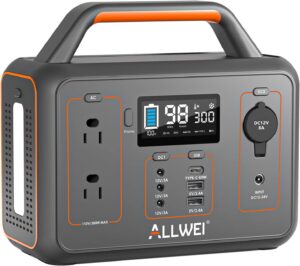

If you’re eyeing those ultra-cheap portable power stations – the ones priced under $100 – it’s important to go in with your eyes open. What can these low-cost units really do, and what are their limitations? This informational guide will break down the capabilities of budget portable power stations (typically small battery generators) so you can set your expectations and avoid disappointment or misuse. We’ll cover typical battery capacity, output power, and suitable devices, as well as the trade-offs that come with the low price tag.
Contents
Small Battery, Modest Power
Under $100 generally means a small battery capacity – usually around 80Wh to 150Wh as mentioned in our best picks. To put that in perspective, 80Wh is like running a 40W lightbulb for 2 hours, or charging an iPhone ~8 times. It’s not a ton of energy. By comparison, more expensive stations might be 500Wh, 1000Wh, etc.
So, with an 80-150Wh unit, you should expect: – Charging phones, tablets, cameras: This they excel at. They often have multiple USB ports and essentially act like a beefed-up power bank. For example, 150Wh could charge a typical smartphone (with ~3000mAh battery) about 10 times or a tablet ~2-3 times. – Running small gadgets: Think LED lamps, Wi-Fi routers, or a fan. Many of these budget stations have a 100W AC inverter (sometimes up to 150W). That means anything that normally plugs in and draws under ~100 watts is fair game. Examples: A 50W box fan – yes, that should run (for maybe ~3 hours on 150Wh). A 15W LED camp light – yes, could run many hours (10+ hours on 150Wh). A radio, sure (they use a few watts). – Laptop use: Most laptops draw around 30-60W while charging/working. A budget station can power that via AC or sometimes a high-power USB-C if available. So you could get a few hours of laptop runtime extension. But note, some high-performance laptops might exceed 100W when stressed – those wouldn’t be ideal on these small inverters.
The built-in inverter: one caveat, often these are modified sine wave (cheaper to produce). That’s fine for simple electronics (chargers, lights). It might make some devices hum or run a tad less efficiently, but generally okay. Don’t use modified sine for sensitive audio equipment or certain medical devices – for those, you’d want pure sine (which usually costs more).
Short Duration for Heavy Use
Because of limited capacity, if you try to use even a modest appliance, it won’t last long. People often ask, “Can I run my TV or mini fridge on this $100 station?” – Technically, if the wattage is under the inverter’s limit, it might turn on. But for how long? For example, a 100W TV on a 100Wh battery – theoretically ~1 hour (100Wh/100W) then it’s empty. A mini fridge might be 50W running but has a big startup surge often >500W, which the small inverter can’t handle, so likely no go. Plus, even if it ran at 50W, 150Wh is 3 hours – not much help for refrigeration.
So, expect under $100 units to be for short-term or light-duty usage. They are not whole-room or multi-day power sources.
Limit of One Device at a Time (Often)
Most of these have low total output, meaning you can’t plug a bunch of things at once, even if they have multiple ports. For instance, a FlashFish 150Wh has a 150W max inverter – that could be one device at 100W and maybe another at 30W, but you’re pushing it. Some units do allow multiple smaller loads (like charging two phones and a laptop concurrently, which might be fine if under the limit). But don’t think of powering, say, a lamp, a fan, and a speaker all at once unless they’re all very low draw (like LED lamp 5W + USB speaker 5W + fan 20W = 30W, okay). Just always keep the sum < inverter limit.
Low-Power DC Appliances Sweet Spot
One thing to note is many sub-$100 stations have 12V DC outputs (like the car cigarette lighter socket and 5.5mm DC jacks). Often the DC output can use the battery more efficiently than the AC (because AC inverter wastes some power as heat). If you have any 12V devices (car fan, car cooler, air pump, etc.), those can run directly and possibly get a bit more runtime.
For example, a 12V portable car cooler that draws 4A (around 48W) might run a bit over 2 hours on a 150Wh station via the DC port. If you tried to run an AC mini cooler of same wattage through the inverter, it might only get close to 2 hours due to inverter losses. Not a huge difference but something.
Recharging the Unit – Expect Slow (on wall and solar)
Budget units often don’t have super fast charging: – Wall Charger: Might be a simple 15V adapter at 2A (~30W charge rate). So a 150Wh unit could take 4-5 hours to recharge. That’s fine for overnight, but not fast like some higher end ones that can charge in 1-2 hours. – Solar Input: They usually support solar, but at low watts (maybe 50W panel recommended, sometimes up to 100W). Don’t expect MPPT solar controllers at this price – often they have simpler PWM, meaning solar charging might be a bit less efficient. So if you connect a 60W panel, maybe you get 40W actual into battery under good sun. That could charge it in say 4 hours of good sun (for 150Wh). – Car Charging: Usually can charge from car 12V, but again at maybe 30-40W rate, so several hours driving needed to full charge.
Build Quality & Longevity
It’s under $100 – mostly plastic build, not ruggedized. Treat them a bit carefully: – They are not usually water-resistant (don’t let them get rained on or dropped in puddles). – The battery inside is likely a standard lithium-ion (NMC) with maybe 500 cycle life. If you use it heavily daily, it will wear out in a couple years. If occasional use, it’ll last longer. At least one model (Bluetti AC2A) uses LiFePO4 which can handle many cycles, but that’s rare in this range unless on sale. – They lack advanced features like app monitoring or detailed displays. Often just a basic LCD or LED bars for battery. So sometimes you won’t know exact percentage or time remaining. It’s a minor thing but manage expectations (don’t expect a fancy UI). – Fans: Some have cooling fans that may run when using the inverter or charging. They can be a bit noisy on cheap units. Not a deal-breaker, but don’t be surprised if you hear a little whirr.
Great for Some Situations, Not All
Ideal uses for < $100 power station: – Weekend camping to charge phones, run LED lights, maybe a small bluetooth speaker. – Emergency kit for short power outages to keep phone charged, radio on, maybe a light. – Students or mobile workers wanting a backup to charge laptop/phone during long study sessions outside. – Running small devices in a shed or during a picnic (like a fan or an air pump briefly). – As a UPS for a wifi router or modem – some people use these to keep internet up during outages. If router draws say 10W, a 88Wh unit can keep it up ~8 hours. However, note the modified sine – some router power supplies might be fine with it, usually yes.
Not ideal for: – Anything requiring high surge power (blender, drill, sump pump, etc.). The inverter will just shut off. – Long-term off-grid living – you’ll want more capacity and solar for that. – Replacing a generator for medium loads – these are nowhere near a generator’s capability in wattage or duration. – Running medical devices for extended time (unless it’s something small like a nebulizer under 100W, but e.g., an oxygen concentrator usually draws more power). – Jump starting cars – these are not jump starters (those deliver high current for short time; these deliver low current steadily). Don’t confuse a “power station” with a “jump starter pack” – different tool (though some jump starters now have inverters too, but that’s another category).
Are They Safe?
Yes, generally. They have internal battery management, won’t let you overdraw, and have inverters that shut off if overloaded. As long as you use properly, there’s not much risk. Just don’t try to open them or modify them. Also avoid extreme heat and cold – like don’t leave it baking in a car dash (battery hates that). And don’t charge it below freezing (most will not allow it anyway until it warms up, to protect battery).
Bottom Line of Expectations
For under $100, expect a handy little backup power source that’s great for charging devices and running a few low-power appliances for a limited time. It’s like having an extra large battery bank that also has an AC wall plug. If you frame it that way, you’ll likely be pleased with it.
You won’t be powering your refrigerator or home heater with this – but you will be able to keep your phone alive, your camp illuminated, and your small electronics humming when you’re away from outlets or the grid goes dark briefly. Considering the low cost, that’s still a lot of utility packed into a box the size of a lunchbox or thermos. Just match your expectations to the capabilities above, and you’ll find a sub-$100 portable power station can be a very worthwhile gadget in your collection.