

When you’re off the grid and the heat is on, what’s the best way to keep cool without plugging into the power company? Off-grid living forces you to think creatively about cooling: you might be choosing between running a battery-powered fan vs. a portable AC unit, or even more low-tech solutions. In this article, we’ll explore cooling alternatives for those living or camping off-grid. We’ll weigh the pros and cons of using a portable air conditioner versus simpler fan-based solutions when you’re limited to battery or solar power. The stakes are high – it’s not just about comfort, but sometimes safety in extreme heat. The trick is balancing energy use with cooling effect. Let’s break down the options so you can stay cool without blowing through your entire power budget.
Contents
Option 1: Portable Air Conditioners (The “Real” AC Experience)
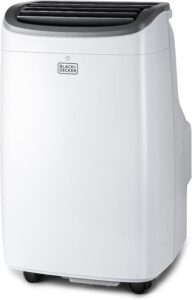

Portable air conditioners (we’re talking about those small AC units with compressors, not evaporative “swamp” coolers) can actually cool the air and lower ambient temperature. Off-grid, you’d likely be using one of three types: – A small window AC unit (like 5,000-8,000 BTU) mounted in a cabin window or van. – A portable floor AC with an exhaust hose you stick out a window (similar BTUs). – A 12V DC air conditioner designed for vehicles or RVs (these are less common and usually still draw lots of power).
Cooling Power: These will definitely make a space cooler. A 5,000 BTU AC can cool a small room or a well-insulated van interior by several degrees, removing moisture too (so it handles humidity, which fans do not).
Power Draw: Here’s the rub – they need a lot of power. Even the smallest AC units usually start around 400-500W consumption at minimum, and most are in the 500-800W range for portable units. That’s a lot of juice if you’re on battery/solar. For perspective, if you had a 100Ah 12V battery (~1200Wh usable), a 500W AC could drain it in about 2 hours. So running AC off-grid typically demands a sizable power system (large battery bank + significant solar panels to recharge daily).
Efficiency Considerations: Portable AC units aren’t particularly efficient for off-grid, but they are sometimes necessary (e.g., in very humid areas where just moving air with a fan won’t cut it, or if you have medical needs for cooling). One strategy is to run AC only during the hottest part of the day, possibly directly off solar (so you’re not cycling the battery as much). If your solar can cover a portion of the AC’s draw, that helps. Also, use the AC in the smallest space possible – maybe cool one room or a tent rather than the whole cabin. Insulate that space as best as you can to keep the cool in.
Bottom line for AC off-grid: It will truly cool but at a high energy cost. You’ll need to ration its use or have a heavy-duty off-grid power setup. Many off-gridders use AC as a last resort, maybe for a few hours in the peak of a heatwave, or only when the solar panels are cranking and batteries are full.
Option 2: Fans (Airflow for Cooling Effect)
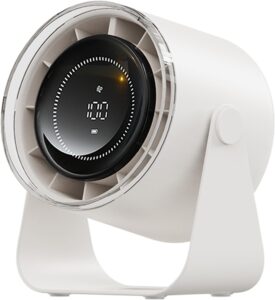

Sometimes the old-fashioned solution is best: fans. Whether it’s a ceiling fan in a cabin, a 12V RV fan, or a simple battery-operated fan, moving air can make a big difference in comfort: – Cooling Mechanism: Fans don’t lower air temperature, but by moving air over your skin, they speed up evaporation of sweat, which cools you down. This “wind chill” effect can make you feel several degrees cooler than the air temp. It’s only effective if the ambient humidity isn’t too high (in super humid climates, fans help less because sweat doesn’t evaporate readily). – Ultra-Low Power: Fans are incredibly frugal with electricity compared to AC. For example, a typical box fan might use 50-100W on high speed, and smaller clip-on fans might be just 5-20W. There are also efficient 12V fans designed for camping that sip power slowly. Compared to AC, fans use roughly 1% of the electricity to provide cooling sensation. That means you can run a fan all day on what an AC would use in minutes. – Runtime Off-Grid: With modest solar or battery, you can run fans basically indefinitely. For instance, a 12V fan drawing 2 amps (around 24W) could run 10+ hours on a 20Ah battery. Many off-grid dwellers place multiple fans around – one blowing in cooler outside air at night, others circulating inside.
Different Fan Setups: – Ceiling Fans: Great for cabins or tiny homes with inverters – a modern efficient ceiling fan might use 20-50W on low/medium. They can really help distribute warm air up high and keep a circulation. – Portable DC Fans: USB fans or 12V plug fans are perfect for van life or tents. They might be small, but if you put them close to you, they provide personal cooling effectively. Bonus: many are quiet and have adjustable speeds. – DIY “Swamp Cooler” Fan: In dry climates, you can enhance a fan’s cooling by hanging a damp cloth in front of it or placing a pan of water so the fan blows across it. This effectively creates an evaporative cooler, adding a bit of humidity but drastically cooling the air in arid conditions. Just be careful not to spill water on any electronics, obviously.
When Fans Are Best: If you’re in a climate where nights cool down, a fan drawing in cool night air through a window can flush out heat from your dwelling. In the daytime, shade and ventilation plus fans can keep it bearable up to a point of external heat/humidity. They’re ideal for when it’s warm but not brutally hot, or when humidity is moderate.
Option 3: Evaporative Coolers (Swamp Coolers) – Middle Ground
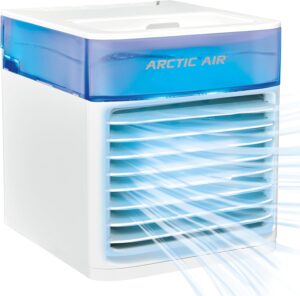

An honorable mention: evaporative coolers, often called swamp coolers. These devices use a fan to draw air through a wet medium (pad or filter), and the air is cooled by evaporation. They actually cool the air a bit (unlike a plain fan) but not as much as AC, and they add humidity. They only work well in dry climates; in humid places they can make it worse.
- Power Use: Generally higher than a plain fan but much lower than AC. For example, a portable swamp cooler might use 50-100W (mostly for the fan) plus a water pump. Still a fraction of AC power.
- Cooling Effect: In dry air, they can drop the temperature by 5-15°F depending on conditions. It feels like a cool breeze. They also hydrate the air which can be good or bad (good if it’s desert-dry, bad if it’s already muggy).
- Off-Grid Suitability: If you’re in say, the Southwest US or a desert area off-grid, evaporative cooling is very popular because it’s efficient. Many off-grid homes have roof-mounted swamp coolers that run on solar. If humidity is under ~30-40%, these shine.
In a comparison sense, evaporative coolers are closer to fans in power usage but closer to AC in cooling effect (in the right climate). They do consume water though – you need a water supply to keep feeding them, as the water evaporates into the air.
Which to Choose? (Scenario-Based Advice)
- If you have limited power (small battery, small solar): Stick to fans. Plan your day around natural cooling – use shade, avoid heat buildup, ventilate at night, and use fans to keep air moving over you. You’ll get the most “cooling per watt” this way by far.
- If you have moderate power and it’s dry heat: Consider an evaporative cooler or a DIY equivalent. It can make midday heat more tolerable at a relatively low power cost. Pair it with fans for distribution.
- If you have substantial power resources or absolutely need true cooling: Then a portable AC might be viable for you. For example, some van lifers with 400Ah of lithium batteries and 600W of solar can manage a rooftop 12V AC for a couple hours a day. If you’ve got a cabin with a big solar array and a couple powerwalls, sure, run a minisplit AC unit. It’s all about the energy budget.
- Emergency cooling in extreme heat: Even if you normally rely on fans, it’s not a bad idea to have a backup plan (maybe a small generator or a larger power station) to run an AC for a short time if you get a dangerous heatwave. Off-grid doesn’t mean you have to suffer – safety comes first. Maybe you fire up that generator for an hour of AC siesta in the worst heat of the day, and use fans otherwise.
Personal Comfort vs. Power Trade-off
Fans are inclusive for everyone’s power budget – almost anyone off-grid can run a fan or two around the clock with a basic solar panel and car battery setup. It’s a common starting point. You get used to aiming fans at you, using spray bottles of water on your skin (evaporative cooling on the body!), and taking advantage of breezes. It’s a more direct cooling – you cool the person, not the whole room.
Air conditioners, on the other hand, aim to cool the ambient environment – which is luxurious but power-hungry. Off-grid, that kind of luxury requires investment. When you’re sweating in a tiny home at 95°F, it might sound worth any cost – but you have to haul fuel or install a lot of solar to maintain it. Some off-grid folks do treat themselves to a window AC running off a generator for a bit each afternoon. It’s all about what creature comforts you prioritize.
One more note: insulation and design of your off-grid dwelling can’t be overstated. The best way to stay cool is to reduce how much heat gets in. Reflective barriers on windows by day, good insulation in walls and roof, ventilation that releases hot air at the top – all passive moves that make whatever cooling method you choose more effective. If you can keep your space 10°F cooler than outside just by design, then fans might be enough where otherwise you’d think you need AC.
Final Words
For off-grid living, fans (and evaporative coolers in dry climates) are usually the MVPs of cooling due to their low power requirements. A simple fan uses so little power that, as one example, you could run a fan 24 hours and still use less electricity than an AC would use in 15 minutes. That’s a huge difference. Portable ACs can be used off-grid, but with caution – they’ll chew through your battery reserve quickly, so they’re best reserved for when absolutely needed or when you have ample power generation.
In summary: Use fans to cool people, use AC to cool rooms – and off-grid, it’s often easier to cool the people. By intelligently combining these methods (maybe AC during solar peak, fans at night, a bit of evaporative cooling midday), you can survive and even thrive in the heat while staying within your off-grid power means. Stay cool out there!