

When debating a mid-range power station (~$300-$500, around 500Wh capacity) versus a high-end unit (~$1000+, 1000Wh or more), it helps to know exactly what you’re getting – and giving up – with each. Let’s break down the key differences in capacity, output, features, and practicality to understand the trade-offs. In short, a mid-range model offers portability and affordability but with limits on power and runtime, while a high-end station delivers more juice and bells & whistles at the cost of size and price. Here’s a friendly comparison to guide your choice:

Contents
Battery Capacity & Runtime
Mid-Range (≈300-600 Wh): A mid-range station might power a few lights, charge phones and laptops, and keep a mini-fridge or fan running for several hours. For example, a 500 Wh unit can run a 50W portable fridge for roughly 8-10 hours (assuming ~60% duty cycle) or recharge a typical smartphone 40+ times on one charge. However, it won’t last through multi-day outages without recharging. Mid-range users often prioritize essential devices – you may get through a night with a CPAP or keep a laptop and Wi-Fi router online during a short blackout, but running larger appliances is mostly off the table.
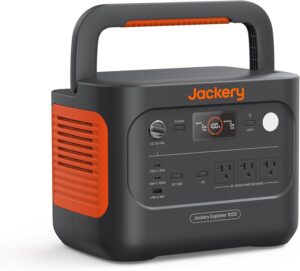
High-End (≈1000+ Wh): High-capacity stations provide significantly longer runtime and can handle bigger jobs. A ~1000 Wh power station (like a Jackery Explorer 1000) can run a 60W mini-fridge for 13-15 hours or a 5W LED lamp for nearly a week continuously. In real terms, high-end units can keep a household’s critical devices (fridge, internet, lights) running through an overnight outage or longer. This extra capacity is also useful off-grid – for example, powering a whole campsite with lighting, fans, and device charging for a full weekend, or running power tools for hours on a job site. Essentially, you sacrifice runtime with a mid-range: high-end models have about 2× to 3× the capacity, meaning far fewer worries about frequent recharging.
Inverter Power (Wattage)
Mid-Range: Typically comes with inverters rated around 300W to 600W continuous output. This is enough for basic electronics and small appliances but a limiting factor for anything power-hungry. You’ll run laptops, TVs, fans, small projectors, and charge e-bikes just fine. But try to plug in a microwave ( ~1000W) or a hair dryer (1500W) and a mid-range inverter will either shut off or blow a fuse. Even some toasters, coffee makers, and vacuum cleaners exceed mid-range limits. In short, with a mid-range unit you sacrifice the ability to run high-wattage appliances. You must plan around that – e.g. boil water on a camp stove instead of an electric kettle, or use a manual tool instead of a power saw.
High-End: Usually boasts inverters from 1000W up to 3000W continuous, depending on the model. This opens up a whole new world of device compatibility. A 1000W inverter can handle kitchen appliances like blenders or a full-size refrigerator (the fridge’s compressor cycles on ~120-200W, but needs ~1200W surge which these larger inverters can supply). Top-tier 2000W+ stations can even run power tools, well pumps, or small air conditioners. Essentially, with high-end units you can operate almost any household appliance (one at a time, within reason). The sacrifice here is mainly cost and portability – you pay more for that capability, and the unit is heavier – but in terms of using high-watt devices, you sacrifice very little. High-end models often have robust pure sine wave inverters with high surge capacity, so even startup surges of devices (fridges, drills) are handled gracefully. With a mid-range, you accept that many heavy-duty items are off-limits or you’ll need an alternative solution.
Portability & Weight
Mid-Range: One big advantage you get here is easier portability. Mid-range stations, with their smaller batteries, usually weigh in the ballpark of 10 to 15 pounds (for ~500Wh LFP units it can be a bit more, around 15-17 lbs). They often come with a carry handle and compact form factor – about the size of a small cooler or car battery. This means you can toss them in the trunk for a camping trip, carry them from room to room during an outage, or even take them on a flight if under airline limits (note: most mid-range ~500Wh units actually exceed the 160 Wh airline battery limit, so they are not flight-friendly; only much smaller units are). Still, mid-range models are generally manageable by one person and storable in a closet. In choosing mid vs. high, you sacrifice some portability when you go high-end.
High-End: These can get hefty. A ~1000Wh power station often weighs around 20 to 25 pounds (Jackery Explorer 1000 is ~22 lbs, for instance). As capacity and inverter power go up, so does weight – 2000Wh units can be 45-60 lbs, often requiring wheels or two people to move. Manufacturers try to include telescoping handles and wheels on 1000Wh+ “solar generators” because they’re essentially like small suitcases or roller luggage in weight. If you live in a multi-story home, lugging a 60 lb unit upstairs during an emergency is no fun. So with high-end units, you sacrifice the easy grab-and-go nature of mid-range. High capacity models are less travel-friendly – you probably won’t take a 1000Wh station backpacking or even tailgating without some effort. Mid-range shines here for mobility.
Battery Chemistry and Lifespan
This can vary, but generally:
- Many mid-range units (especially older or budget ones) use NMC (Lithium-ion) batteries with around 500 charge cycles. Some newer mid-range models are moving to LiFePO₄ (LFP) chemistry, which offers 2000+ cycles, but often at a slightly higher price or lower capacity to stay under $500. You might sacrifice battery longevity in a mid-range if it’s not LFP. For example, Jackery’s mid-range use NMC (500 cycles to 80%), whereas BLUETTI’s mid-range (EB series) use LFP (2500 cycles). Check the spec: choosing mid-range might mean shorter lifespan unless you pick one with LFP.
- High-end models more commonly feature LiFePO₄ batteries due to their larger size and use-case for daily cycling (Bluetti AC200P, EcoFlow Delta Pro, etc., often LFP). They are designed to last years even with frequent use. So by going high-end, you often gain a longer lifespan and better heat tolerance. The trade-off is mostly cost; LFP is pricier cell tech, contributing to the higher price tag of high-end units. If a mid-range uses NMC, you sacrifice some durability; if it uses LFP, then you’re on par in this department.
Advanced Features and Expandability
High-end power stations tend to be feature-rich compared to their mid-range cousins:
- Solar Input & Charging Speed: High-end units often have higher solar input capacity (e.g. 2× or 3× 200W panels) and faster AC charging (some 1000Wh stations take in 800W+ from the wall, charging in 1-2 hours). Mid-range might limit to 100W-200W solar input and take 6-8 hours to charge on AC. You sacrifice charging speed and flexibility with mid-range. For instance, EcoFlow’s high-end Delta series can charge to 80% in under an hour, while a mid-range Jackery 500 takes 7+ hours.
- UPS Functionality: Some high-end models include UPS (Uninterruptible Power Supply) mode – they automatically pass through grid power and switch to battery during an outage with minimal interruption. Mid-range units rarely have true UPS functionality. So if you want to use a station as a backup for a desktop PC or medical device, the high-end has the edge (mid-range you’d have to turn it on manually when needed).
- App Connectivity & Smart Features: High-ends often come with Bluetooth/WiFi apps to monitor usage, update firmware, etc. Mid-range units are usually more “analog” – button-operated with basic LCDs. Fewer frills.
- Number of Ports: High-end stations frequently come with more output ports (multiple AC outlets, more USB ports, even 240V capability by linking two units, etc.). Mid-range have fewer outlets (often 1 or 2 AC). If you have a lot of devices, a high-end accommodates more simultaneously.
- Expandable Capacity: A major feature in some $1000+ systems is the ability to add external battery modules. For example, EcoFlow Delta 2 can hook up an extra battery doubling capacity; Bluetti AC300 is a modular system; etc. Mid-range units do not support expanding – what you buy is the max capacity. So you sacrifice any scalability with mid-range. High-end can be part of a larger home backup system if needed – mid-range is a standalone appliance only.
In summary, mid-range power stations sacrifice some of the advanced features and expandability that high-end models boast. But if you don’t need those extras, a mid-range’s simplicity can be a plus (less to configure, generally just plug-and-play).
Price vs Value
It almost goes without saying: mid-range units are far cheaper, often 2-3× less cost for half the capacity of high-end. You might pay ~$0.80 to $1 per Wh in a mid-range, whereas high-end could be $1+ per Wh. For example, a popular 500Wh mid-range might be $450, while a 1000Wh high-end is $1000 (not linear scaling in price). However, consider value: if a mid-range covers your needs 90% of the time, you save a lot of money. High-end makes sense if you truly need the extra oomph or plan to use it very frequently (daily cycling, off-grid living, heavy appliance use).
One strategy some people take: start with a mid-range for occasional camping or short outages. If you find its limits frustrating (e.g., you really wish you could run a microwave or you keep running out of battery), then upgrade to high-end later. Just be mindful that some mid-range units have lower resale value – but top brands hold value pretty well if you upgrade.
Practical Example Comparison
- Use Case 1: Camping Weekend – Mid-range (500Wh) will run a few LED lights, a portable speaker, keep phones charged, maybe run a CPAP for a night (with ~40W draw, a 500Wh can do ~8-10 hours). High-end (1000Wh) could do all that and also power an electric cooler for two days or a projector for movie nights. If you’re glamping with gadgets, high-end ensures nothing dies; mid-range means prioritizing what to power or bringing a solar panel to recharge.
- Use Case 2: Home Emergency – Mid-range can keep basics like phone, radio, a lamp, and maybe your internet router going through a 8-hour outage. But it probably won’t run your fridge effectively (maybe 5 hours max for a mid-size fridge). A high-end ~1000+ Wh can indeed run a fridge in intervals and keep more of the house running (fans, laptop, router, lights) for a day or two. High-end units start encroaching on generator territory in capability – without the fuel or noise.
- Use Case 3: Job Site or DIY – Have a power tool (say a drill press or circular saw drawing 800W)? Mid-range is a no-go (inverter too weak). High-end 1000W+ can handle it for moderate tasks. If you’re charging power tool batteries and running small tools, high-end gives you cushion, mid-range might trip on surge loads. Also, high-end with >1000W inverter can run multiple devices at once (drill + work light + phone charger), whereas mid-range you must stagger usage to stay under 500W total.
Choosing mid-range vs high-end comes down to your power needs and budget. By opting for a mid-range power station, you sacrifice capacity (runtime) and appliance compatibility in exchange for a much lower cost, lighter weight, and easier portability. It’s a great trade-off if your intended use is charging devices, running a few small electronics, or short off-grid stints. However, if you anticipate longer power outages, want to run energy-hungry appliances, or desire advanced features like fast recharge and expandability, a high-end station pays off – albeit at a significantly higher price and in a heavier package.
In other words, mid-range is like a reliable compact car – affordable and gets you there most of the time, high-end is the 4×4 SUV – more power for tough situations but you’ll invest more up front. There’s no “one-size-fits-all”: consider what you need to power and for how long. You might find that a mid-range unit covers 95% of scenarios (and your budget will thank you), or you might realize that only a high-end can provide true peace of mind for your use-case. Now that you know what each entails, you can make that call with eyes wide open!