

Stepping up to a 1002Wh battery, the Jackery Explorer 1000 is a heavyweight contender. In a world where whole-house and large-area power solutions are growing, a 1kWh portable unit is rare. Analysts note this market is booming – forecast to hit around $1.1 billion by 2032. Jackery’s large units like the 1000 are part of that trend. With roughly a kilowatt-hour of energy, the Explorer 1000 can run small appliances and multiple devices all day.
Jackery 1000 User Guide – Tips for Charging, Storage, and Optimal Use
To keep your Jackery 1000 in top shape, follow a few tips. Charging: Use the factory charger for AC charging; it’s size-safeguarded. For solar charging, match panel wattage to about 200-400W for steady input. Avoid draining it to 0% too often – try to recharge once it hits 20-30%. If storing the unit long-term, keep it at about 50% charge and in a cool location. Usage: Connect high-draw devices (like a fridge or power tools) only one at a time, to avoid overload. The Jackery has built-in protections, but it’s good practice. Turn off any AC outlets when not in use to save battery. General: Clean the ports and vents periodically. If using the Jackery in very hot or cold weather, be aware efficiency changes. In extreme cold, battery capacity effectively drops, so indoor storage overnight helps. Following these simple steps will give you reliable performance and a long lifespan from the Explorer 1000.
Jackery Explorer 1000 – Big Capacity, Big Possibilities
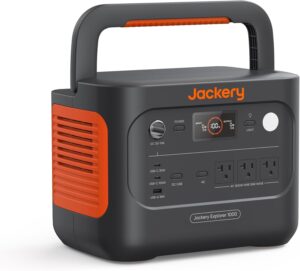

The Explorer 1000 boasts 1002Wh of lithium battery power and a 1000W pure sine inverter. This unit has three AC outlets (110V) so you can plug in lamps, small fridges, or tools. It also provides USB-A, USB-C, and a car port. Recharging is smart: it supports AC charging (about 6 hours to 80%) and solar charging via an MPPT controller. Because of its large battery, the 1000 is ideal for home backup and extended off-grid use. For instance, it could power a 60W mini-fridge for 15-18 hours or provide dozens of full phone charges.
- Capacity & Output: 1002Wh battery, 1000W AC inverter (2000W surge).
- Ports: 3×AC outlets, 2×USB-A, 1×USB-C (60W), 1×12V car port.
- Recharge: AC charger (≈6-7 hrs to 80%), solar (with suitable panels).
- Features: LED display, multiple recharge methods, and built-in MPPT for efficient solar use.
Jackery 1000 vs Jackery 500 – Jumping to a Higher Capacity
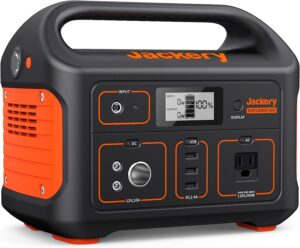

The jump from 500 to 1000 is dramatic. The 1000 has nearly double the storage of the 500 (1002Wh vs 518Wh). That means you can run twice as many devices for the same time, or run larger loads. For example, if the 500 could keep your router and a few lights on for a weekend, the 1000 could handle a small fridge as well. The output capability also doubles (1000W vs 500W), so you can run heavier appliances. This upgrade is worth it if you need serious off-grid power. On the downside, the 1000 is heavier and more expensive, so evaluate if you truly need that extra capacity or if 500Wh was already enough.
Jackery 1000 vs EcoFlow Delta 2 – Competing 1kWh Power Stations
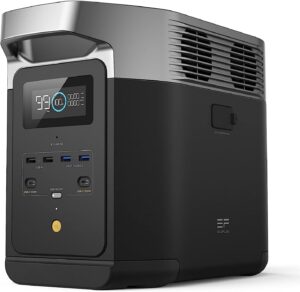

A key competitor is the EcoFlow Delta 2. Both have around 1kWh of battery. The Delta 2 uses a 1024Wh LiFePO₄ cell and can output up to 1800W (or 2200W with its X-Boost). By comparison, the Jackery 1000 has a 1000W inverter. This means the Delta 2 can run bigger appliances (like a microwave) that the Jackery cannot. On the other hand, Jackery’s model is simpler with fewer ports. Both support solar charging. The Delta 2’s rapid charge feature (≈1.6hrs to 80% on AC) is impressive. So the Delta 2 is more powerful and faster to recharge, while Jackery 1000 is very straightforward and rugged. If you need maximum power output, Delta 2 wins; if you prefer a proven tried-and-true unit, Jackery is solid.
- Jackery Explorer 1000: 1002Wh, 1000W output. Good for everyday camping or light home backup.
- EcoFlow Delta 2: 1024Wh, 1800W output. Handles heavier appliances and charges very fast.