

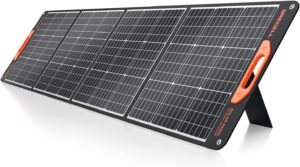

So, you’ve got a portable power station and you want to harness the sun to charge it – great idea! Choosing the right solar panel (or panels) for your power station is crucial to get the best charging performance. Let’s break down what you need to consider, especially focusing on wattage and compatibility:
- Check Your Power Station’s Solar Input Specs: Start here, because this dictates everything else. Look in the manual or spec sheet for something like “DC Input” or “Solar Input.” You’ll usually see a voltage range (V) and current (A) or wattage (W) limit. For example, it might say “Supports 12-60V, up to 10A (500W max)” for a given unit. This tells you what panels (or how many) will work. If your station’s max is 60V, you must keep the panel array’s open-circuit voltage under that. If max current is 10A, that is usually the limit of the MPPT controller.
- Wattage: The max wattage (e.g., 100W, 200W, 500W) the station can use is key. If it says 200W max, buying more panels beyond 200W won’t charge it faster in perfect sun – you’re capped. Many medium stations (500-1000Wh range) might max around 100-200W solar input, while bigger ones (1500Wh+) accept 400-800W or more. For instance, the EcoFlow Delta 2 can take 500W, the Jackery 1000Pro up to 800W, etc. Aim to get panels whose combined wattage is near the max (if you want the fastest charging). If you undershoot severely (like only 50W panel for a system that can take 500W), charging will be very slow.
- Voltage Compatibility: Solar panels have something called “Vmp” (voltage at max power) and “Voc” (open-circuit voltage). Your station’s input range (e.g., 11-50V) must encompass the Vmp of your panel setup. Many portable panels (50W-200W) are 18V nominal (Vmp ~18V, Voc ~21V). These are fine for most power stations which usually want 12-30V input at least. Some larger panels (or chaining panels in series) can produce 36V, 48V, etc. If you string panels in series, voltages add up! Two 18V panels in series = ~36V Vmp (~42V Voc). That could still be okay for a unit with <60V limit, but three in series (~60V Vmp, 75V Voc) would exceed a 60V limit – not okay. Exceeding voltage limit can damage the MPPT or trigger protection. So you might wire panels in parallel instead to keep voltage low but increase current (though current limited by the A max).
- Connector Type: Most panels have an MC4 connector (industry standard two-wire connector). Most power stations either come with an MC4 to their input adapter or use something common like an Anderson Powerpole or 8mm barrel. Adapters are widely available. For example, Goal Zero uses an “HPP” (High Power Pole) connector on bigger Yetis, but sells MC4-to-HPP cables. Jackery uses 8mm barrel inputs; they provide an MC4 adapter cable with their units (usually). EcoFlow uses XT60; again, often included. Check what’s included. If not, you’ll need to purchase the correct adapter.
- Decide on Panel Wattage (or Panels) Based on Your Needs: If you want to maximize charging, get enough panel wattage to hit your station’s input limit in good sun. For instance, if your station maxes at 200W, a single 200W panel or two 100W panels (wired appropriately) is ideal. If you get 100W of panel for a 500W-capable station, you’re bottlenecking at the panel – it will charge, but slowly (taking perhaps 5x longer than it could). On the flip side, if portability is key, you might accept less panel wattage for easier transport (like one foldable panel instead of three). Also consider typical sun conditions: 200W of panels might only give ~140W in real conditions at noon, maybe less in morning/evening. Having a bit extra panel wattage ensures you get closer to the max input for more of the day.
- Portable vs Rigid Panels: Portable folding panels (often 60W, 100W, 200W) are convenient and lightweight, great for camping. Rigid glass panels (like home rooftop style 100W, 200W panels) are cheaper per watt, but bulkier and heavier. If this is primarily for home backup, rigid panels could be fine (you can set them up temporarily during outages). For travel, the folding briefcase or flexible panels are much easier. The power station doesn’t care which type, as long as voltage/current are in range. For example, a 100W Renogy rigid panel and a 100W Jackery SolarSaga panel both produce ~18V – either will charge a Jackery power station similarly (the difference is durability and portability).
- Series vs Parallel Panel Connections: If you have a power station with a higher voltage allowance, you can connect panels in series to reach that voltage (this can be efficient under certain conditions). If the station prefers lower voltage/high current, you might connect in parallel. Example: Bluetti AC200Max wants 35-150V input. You could take three 200W (Vmp ~20V) panels in series (~60V) to be in that range. But an EcoFlow River wants 10-25V – you’d wire panels in parallel to keep voltage ~18V but increase amps. Many mid-range stations can accept series of two panels (e.g., two 100W in series = ~36V, which is okay for up to 50V input). Parallel wiring keeps voltage same as one panel, but currents add (need a parallel connector and beware of current limit). Also note: in parallel, currents add and might exceed the A limit of the controller (if spec says 10A max and you parallel two panels that each can give 6A, that’s potentially 12A – the controller will likely cap it or not work efficiently).
- Consider Panel Quality and Real Output: Not all “100W panels” give 100W in typical use. High-quality monocrystalline panels with good efficiency and ETFE coating (for portables) tend to perform better. Some foldable panels might only realistically output 80W at noon even though rated 100W. Rigid panels often meet specs under ideal conditions. Read reviews or tests if possible. If in doubt, maybe overspec a bit on panel wattage to account for losses. Also consider environmental factors: if you’ll frequently be in sub-optimal sun (morning/evening, winter angle, partial shading), having extra panel capacity or a flexible panel positioning scheme helps.
- Durability and Weather: Are the panels going to be out in the elements? Many portable panels are water-resistant (can handle occasional rain) but not meant for permanent outdoor mounting. Rigid panels are weatherproof but have glass that can be broken if mishandled. If you camp in rough conditions, you might want panels known for ruggedness (there are some rollable or fabric-based ones that are virtually unbreakable, but they cost more).
- Expansion Plans: Maybe you start with one panel and plan to add another later. That’s fine – just ensure the connectors can accommodate chaining (most have MC4 which is modular). If you do add later, re-evaluate if series/parallel or a mix is needed. Always stay within voltage/current limits of the station.
- Efficiency of Charging: As a tip – tilt your panels toward the sun for best results. Even the best panel won’t give full wattage if just laid flat (unless sun is directly overhead). A portable power station with an MPPT will try to optimize, but you have to feed it sunlight. Expect about 5-6 hours of peak sun equivalent per clear day (depending on location/season). So if you have a 200W panel and 1000Wh station: 200W * 5h = ~1000Wh – you could fully charge in a day of good sun. That rough math helps gauge how many panels you need to meet daily usage.
Real Example: Suppose you have an EcoFlow Delta 2 (1024Wh, 500W max solar, 11-60V). A good pairing might be two 200W panels in series (giving ~40V, ~10A, ~400W), or three 160W panels (in series gives ~60V, 8A, ~480W). That would charge the Delta 2 from empty to full in around 2.5-3 hours of strong sun. If you only had one 100W panel (~18V, 5A, 90W actual), it would take all day (and possibly more than one day) to fully charge the Delta 2. So matching panel wattage to the device’s capacity and input limit is key for efficiency.
In summary: – Choose panels or combination whose voltage fits in your power station’s input window. – Aim for total wattage close to the station’s solar input max for fastest charging, given your portability needs. – Ensure you have or get the proper adapter cables (MC4 adapters etc.). – Use series/parallel wiring appropriately to meet voltage vs. current requirements (don’t exceed limits). – Consider physical aspects like portability, weather resistance, and ease of setup when selecting panel type.
By picking the right solar panel setup, you’ll maximize the free energy you can pull from the sun and keep your portable power station charged up and ready to go wherever you are. It’s a great feeling watching your battery level climb under bright sunshine – like sipping power from nature’s tap!