

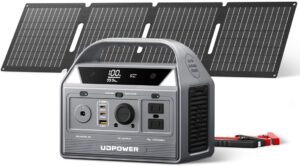

Congratulations on your new solar generator kit! Getting it up and running is straightforward, but there are a few tricks to setting it up for optimal performance. Here’s a step-by-step guide and some tips for the first-time setup of your power station + solar panel bundle:
- Unboxing and Inventory: First, lay out all the components. You should have the power station itself, the solar panel(s), and connecting cables/adapters. Read any quick-start leaflet – it often highlights anything special for that model. Verify that your power station has some initial charge (most come with 50+% battery for safety shipping). If it’s low, you might want to charge it from AC initially, but it’s not strictly necessary to do before solar use.
- Choosing the Right Placement for Panels: Find a spot with abundant sunlight for most of the day. South-facing (in the northern hemisphere) with no shadows is ideal. If you’re home, your backyard or driveway might work; if camping, an open field or clearing. Avoid areas where shadows of trees or structures will hit the panel during peak sun hours (10am-3pm). Even partial shading can significantly drop power output. Also, consider the time of year – in winter the sun is lower, so make sure no long shadows (like from a house) will cover your spot as the sun moves.
- Setting Up the Panels at the Correct Angle: Most portable panels come with kickstand legs or a carrying case that doubles as a stand (like EcoFlow panels). Use these to prop the panel toward the sun. Angle adjustment is key – in the morning/evening, tilt more vertically; midday, flatter. As a rule: set the panel at roughly the same number of degrees as your latitude toward the sun for an average, or eyeball it – adjust until the panel faces the sun directly (you can gauge by minimal shadow of the panel itself on the ground – when it’s almost not casting a long shadow, it’s directly facing the sun). You can adjust a couple times throughout the day for maximum capture. If your panel is bifacial (collects from both sides), you could lay a reflective surface (like a white board or light concrete) underneath to get a bit more from the back – but that’s a bonus step.
- Connecting the Panels to the Power Station: Use the provided cable to connect. Typically, you’ll plug the panel’s MC4 leads into either an adapter (to 8mm, Anderson, or XT60 depending on your station) then into the power station’s solar input port. Ensure the connections are tight – MC4 connectors “click” together; barrel plugs insert fully. Make sure polarity is correct (if using raw MC4 to a bare input – though most use keyed connectors so you can’t mess that up easily). If you have multiple panels, connect them exactly as the manual suggests (series vs parallel) using the included branch connectors. For example, for two panels with Jackery, use the Y branch cable to parallel them. For EcoFlow, two 220W panels go in series (the MC4 from one plugs into MC4 of the next, then the remaining free positive and negative go to the adapter).
- Positioning the Power Station: Keep the power station itself in the shade if possible, or at least out of direct noon sun. High temperatures can reduce charging efficiency and stress the battery. The cord between the panels and station is usually a few meters – you can use that to set the station under a tree or behind the panel where it’s shaded by the panel itself. Just ensure it’s protected from any chance of rain or puddles. Many are somewhat splash-resistant but best not to get them wet. If needed, you can drape a light-colored cloth over the power station to keep it cool (not covering its vents though).
- Monitoring the First Charge: Once connected, your power station’s display should show that it’s receiving charge (usually in watts). For instance, it might say “Input: 120W”. If it’s much lower than expected for the panel wattage and the sun is bright, adjust the panel angle or check for any cable issues. On first setup, it’s satisfying to watch the watts climb as you angle the panel better. If your station has an app, you might use it to monitor from shade. Initially, you might see the input fluctuate a bit due to clouds or angle tweaks – that’s normal.
- Using the Power While Charging (if needed): Most power stations allow pass-through usage, meaning you can draw from it while the panels charge it. On your first go, maybe keep the output devices minimal to see how the charging goes. But if you need to plug something in, feel free – just note that if you draw, say, 50W for a laptop and the solar is giving 100W, the net charging is 50W (100 in minus 50 out). The display often shows net input or both input/output. A tip is to try not to max out the inverter while solar charging, as that can generate heat – but occasional use is fine.
- Security of Panels: If you’re in an area with foot traffic or wind, secure your panels. They can be a sail in gusts – you don’t want them to fall over. Use the panel’s grommets to stake it down or place a rock/sandbag on the kickstand to weigh it. Also, if you’re leaving them unattended, consider a light chain or keep them in sight to avoid theft (they’re shiny and can attract attention).
- Evening Storage: After the day, it’s good practice to disconnect or fold the panels. Many power stations will simply stop drawing when sun’s gone (voltage falls below charge threshold) so it’s not a big deal if you leave them, but bringing them in keeps dew or overnight moisture off and secures them. Plus, folding panels away prevents any trip hazard or reflective glare.
- Getting Familiar with Efficiency: You’ll notice on first use that you rarely get the full rated wattage of the panels (100W panel might give 70-80W typical). That’s normal due to angle, temperature, etc. Don’t panic – it’s just how solar works in real conditions. As you set up for the first time, try different panel angles and note the input differences. It’s a quick learning curve and soon you’ll be a pro at finding that sweet spot.
After initial setup, subsequent uses will be quicker – you’ll develop a routine. Maybe mark spots in your yard that get best sun, or set a reminder to adjust panels at noon. The first day is the time to iron out any kinks (like figuring how far the cable reaches, etc.). Once set, you’ll have a reliable power source that’s essentially just there whenever the sun is up. Enjoy the quiet, free energy!