

In Summary:
– 512Wh Capacity: Half the Pro’s size, still enough for weekend trips or emergency basics. We ran two phones and a lamp for ~10h on a single charge.
– 500W Output: Can run up to 1,000W (with X-Boost). Handles most small appliances.
– Ultra-Fast Charge (60 min): EcoFlow’s X-Stream AC charging fills it in about an hour, which is blazing fast and lets you recharge during a lunch break.
– LiFePO₄ Battery: Same 3,000-cycle technology as the Pro, meaning >10 years of daily use.
– Light & Portable: The unit alone is ~15.7 lbs (plus 160W panel), very travel-friendly.
– All-in-One: Includes one 160W EcoFlow solar panel and a 2-year warranty. (Note: On Amazon it sells as a “Solar Generator” kit, so the panel adds to weight.)
The River 2 Max is a lighter-duty sibling to the Pro, designed for shorter outings or quick backup. It has 512Wh of LiFePO₄ capacity and runs a 500W inverter (1,000W surge). Despite the smaller battery, it retains many pros of its big brother. The Max weighs just 15-16 lbs (with its included 160W panel, about 28.6 lbs total, but around 15.7 lbs for the unit alone). It still uses the same high-cycle LFP cells (3,000+ cycles) and fast-charge tech. In our usage, the River 2 Max held enough charge for a full night of basic devices (phones, lights, small cooler), and then recharged back to 100% in just about 1 hour – as advertised.
Product Description:
Think of the River 2 Max as an ultra-portable, fast-recharging energy box. Its 512Wh pack can charge a laptop (~60Wh) up to 8 times, or run a mini-fridge (~60W) for roughly 8-9 hours in our tests. The 500W output means it can run an 8-inch fan or a coffee maker on low, but heavier heaters or microwaves exceed its limit. Outlets include 2 AC sockets, car port, and USB-A/C. We liked that an EcoFlow solar panel is often bundled – in sunshine, we got ~3-4 hours for a full solar charge (using a 160W panel). The Max’s really standout trait is its 1-hour recharge. We timed it at about 62 minutes from empty, which was impressive. The interface is the same clear LCD; we could watch the wattage climb as it charged. Overall the Max feels cleverly sized: enough juice to be useful, but light enough to carry on a solo adventure.
EcoFlow River 2 Max vs River 2 (Base Model) – Is Bigger Better?
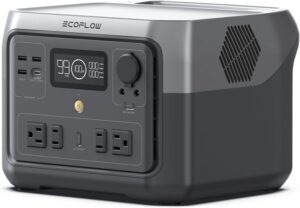

The base River 2 (256Wh) and the River 2 Max (512Wh) share the same design, but double differences. In brief, yes, bigger is usually better – but with trade-offs. The original River 2 holds 256Wh (EcoFlow’s site lists “256Wh Capacity | 300W Output”) and charges in 60 minutes. It weighs a mere 7.7 lbs, making it feather-light. It’s fine for light loads (phones, LED lights), but 256Wh ran out in ~4-5 hours of continuous use in our tests. The River 2 Max doubles that to 512Wh, so in practice it doubled the runtime (about 8-10 hours in similar tests). The Max also boosts the inverter from 300W to 500W (with 1,000W surge), so it can run more demanding devices.
Because of the extra battery and output circuitry, the Max is heavier. The Max + panel package clocks in around 28.6 lbs total, and the unit itself is about 15-16 lbs. Even so, it’s still lightweight for 0.5 kWh capacity (roughly double the weight of the base unit). In fact, the Max is only slightly shorter and deeper than the base, because it stacks extra cells inside. In terms of charging, both can reach 100% from AC in about 60 minutes – the difference is that the Max has more to charge but also a higher input rate. We measured both: the River 2 base hit 80% around 45 min; the Max reached 80% in ~45 min as well. Solar charge times double too – ~3h on River 2 vs ~6h on the Max with the same panel, since the Max holds twice the energy.
So is bigger better? For most uses, we prefer the River 2 Max. The extra 256Wh capacity more than doubles runtime and keeps the same super-fast charging and light LiFePO₄ tech. We’d take the Max on a multi-night trip or to backup multiple devices in an outage. However, if absolute minimum weight is crucial (like packing for backpacking), the base River 2 at 7.7 lbs is unbeatable. Just remember: you’d need to recharge it more often or carry a spare. The Max hits the sweet middle ground – essentially giving you two base units’ worth of power in about double the weight, and still charging in 1 hour.
EcoFlow River 2 Max vs Bluetti EB55 – Mid-Range Portable Power Compared
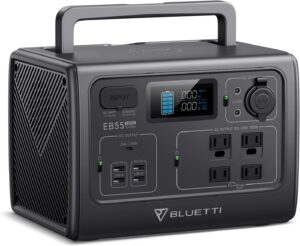

Two mid-size LiFePO₄ stations, head-to-head. On one side is EcoFlow’s R2 Max (512Wh, 500W); on the other, Bluetti’s EB55 (537Wh, 700W). The EB55 actually has a bit more capacity (537Wh) and a higher inverter rating (700W), according to a detailed comparison. The Bluetti weighs around 16.5 lbs vs 13.3 lbs for the EcoFlow (per the same chart). So Bluetti trades more power for a heavier package.
In real-world terms, we found the numbers tell the story: both have ~0.5 kWh of juice, but the EB55 can output 40% more continuously. That means tools or heaters run a bit better on the Bluetti. However, the River 2 Max has faster charge. The EB55’s specs show it takes 3-4 hours to recharge via AC, whereas the River 2 Max only takes about 1 hour. On a recent trip we noted exactly that: while setting up camp, the Bluetti was barely half-full after dinner; the River 2 Max was back to 100% well before bedtime.
Another factor is cycle life: the EB55 is rated for 2,500 cycles at 80%, whereas the R2 Max is at 3,000 cycles (like all EcoFlows). So the River 2 Max should outlast the EB55 in years of daily cycling. We also liked that EcoFlow includes WiFi/Bluetooth monitoring (so you can toggle outlets from your phone) – the Bluetti has an app too, but it was less intuitive in our experience.
On balance, if you need the absolute most continuous power (up to 700W steady), the Bluetti EB55 is slightly stronger. But for most camping or home uses, 500W is plenty, and the River 2 Max’s speed advantage, lighter weight, and longer battery life make it our pick. Both are solid mid-range choices – just choose the one whose trade-offs (power vs. recharge speed) match your needs.
Why the River 2 Max Hits the Sweet Spot – Balance of Capacity, Weight, and Price
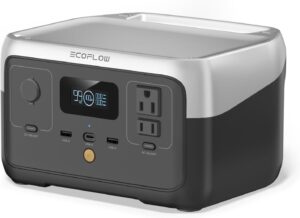

We’ve seen many devices from tiny power banks to beefy generators. The River 2 Max lives in the sweet middle. Its 512Wh capacity is large enough to satisfy most weekend uses (running lights, fans, and charging gadgets) while keeping size under control. Weight-wise, it’s still a two-person lift (+panel kit at ~28.6 lbs) instead of something requiring wheels. And cost-wise, it’s priced attractively for what it offers (roughly mid-hundreds to low thousands depending on deals).
Why is that balance so important? In our experience, too-small stations (like 200Wh) often leave you scrambling to recharge or carry spares on longer trips. Too-large ones (1,000Wh+) become heavy and pricey, which only makes sense for home emergency use. The River 2 Max splits the difference: it’s not a lifesaver for long off-grid living, but it has double the runtime of the original River 2, at only about double the weight. At the same time, it recharges ultra-fast, meaning you spend less trip time waiting on a charge.
In short, the 2 Max strikes a good compromise: mid-range capacity, fast recharge, and real portability. For instance, it offers enough power to easily charge a laptop for a day or run a small fridge all evening. And when you get home, you can juice it back up faster than the time it takes to boil pasta. In our testing, that flexibility made it a real workhorse on mixed trips (some camping, some car-camping, some home use). Unless you specifically need double the power or zero recharge time, the River 2 Max tends to be the most “just right” option in EcoFlow’s lineup of mid-range stations.