

When the lights go out, a $1000 power station can be a hero in your home.
High-capacity portable power stations used to cost an arm and a leg, but in recent years the ~$1000 price bracket has brought serious watt-hours within reach of everyday folks. These “high-capacity on a budget” units typically offer around 800-1200 Wh of battery capacity and robust output capabilities – enough to keep appliances running during an outage or power a basecamp off-grid – without venturing into the ultra-expensive territory of larger solar generators. If you need more juice than mid-range options provide, but still want value for money, this list is for you. We’ll explore some of the best large battery power stations under $1000, along with an intro on why they’re worth considering.
| Product Name | Image | Check Amazon Price and Reviews |
|---|---|---|
| Jackery Explorer 1000 |  | |
| BLUETTI AC180 |  | |
| EcoFlow Delta 2 |  | |
| Geneverse HomePower ONE |  | |
| Anker 757 PowerHouse |  |
High-capacity power on a budget? Absolutely. Consider that Americans experienced an average of 5.5 hours without electricity in 2022 – a big battery can literally be a lifesaver for keeping fridges, medical devices, and heaters running. And with the global portable power market growing fast (projected to nearly double from 2024 to 2032), competition has driven prices down, making ~$1000 units more accessible. Let’s dive into the top picks in this category:
Contents
Jackery Explorer 1000 (1002Wh, 1000W)


Key Features:
- 1000Wh Battery: Provides roughly 83Ah at 12V – plenty to keep essentials running (e.g., can power a 60W TV for ~16 hours, or a CPAP machine ~2 nights).
- 1000W Output: Runs high-watt devices like microwaves or power tools up to 1000W. Pure sine wave output safe for sensitive electronics.
- Multiple AC & USB Ports: Three AC outlets mean you can plug in several items at once (within the wattage). USB-C and A ports keep devices charged without needing adapters.
- LCD Display: Shows input/output watts and remaining percentage. Jackery’s UI is simple and reliable.
- Solar Generator Option: Often bundled with SolarSaga panels – solar-ready with MPPT, making it easy to recharge off-grid in ~8 hours of good sun with 2×100W panels.
Description: The Jackery Explorer 1000 is a poster child for this category – a reliable, well-rounded power station that often retails around $999 (and frequently on sale for less). It packs a 1002 Wh lithium NMC battery and a 1000 W pure sine wave inverter (2000W surge). In plain terms, that’s enough capacity to run a typical home refrigerator for about 8-15 hours (depending on fridge size), or to charge laptops, phones, and power lights for several days. Weighing 22 lbs, the Explorer 1000 is portable enough to haul outside for camping or into the backyard, yet holds serious power. It features 3 AC outlets, 2 USB-C PD (18W), 2 USB-A, and a 12V car socket – a versatile port selection. Jackery’s build quality shines here: this unit is rugged, with an easy-to-read screen and built-in MPPT for efficient solar charging. It can recharge in about 7 hours via AC, or around 8 hours with a pair of 100W solar panels (solar input max ~163W). The Explorer 1000 gained fame from countless YouTube reviews and even a New York Times endorsement as “best portable power station” in 2023. If you want a high-capacity station with a proven track record, the Jackery 1000 is hard to beat.
BLUETTI AC180 (1152Wh, 1800W)


Key Features:
- High-Power Inverter: 1800W continuous output can run nearly any standard 120V appliance (except large 240V items). Great for heavy-duty needs or multiple devices simultaneously.
- LiFePO₄ Battery: ~3500+ cycle life to 80% – built for daily use if needed. LFP adds weight but ensures longevity and better heat safety.
- UPS Mode: Acts as a battery backup with ~20ms switchover – protecting desktop computers or sensitive electronics from outage damage.
- Rapid Recharge: Incredibly fast AC charging (0-80% in ~50 minutes). Also supports dual charging (AC+solar) for even faster replenishment.
- Smart App: Pairs with BLUETTI app via Bluetooth for monitoring, setting inverter eco mode, etc. (Quality-of-life feature for techies.)
Description: For those who need a jump in output power without a giant jump in price, the BLUETTI AC180 is a compelling new entrant (often priced right around $999). The AC180 delivers 1152 Wh of LiFePO₄ battery capacity – yes, LFP chemistry for long life – and an impressive 1800 W inverter (2700W surge). That huge output means it can handle most home appliances and power tools with ease (think full-size refrigerator, microwave, coffee maker, toaster – all within its reach). The unit weighs about 37 lbs; heavier than others here due to the beefy inverter and LFP cells, but still portable with a top handle. It has 4 AC outlets, 1 12V car port, 1 USB-C PD 100W, and 4 USB-A. BLUETTI built in a fast charger – the AC180 can recharge in just ~1.3 hours (90 minutes) from AC, thanks to 1440W input via AC. Solar input up to 500W means you could refill it with solar panels in 3-4 hours of good sun. This model also supports UPS functionality (20ms switch), making it great for home backup of a PC or server. With a 5-year warranty and BLUETTI’s solid brand reputation in high-capacity units, the AC180 stands out as a powerhouse at a budget-friendly price per watt-hour.
EcoFlow Delta 2 (1024Wh, 1800W)


Key Features:
- 02 kWh LFP Battery: High cycle life (≥3000 cycles) and expandable by adding a Delta 2 Extra Battery (up to 2048 Wh total).
- Ultra-Fast Charging: X-Stream AC charging ~1200W input fills 0-100% in ~80 minutes – incredibly convenient.
- High Surge Capacity: 2700W surge handles motor-driven appliances’ startup. X-Boost feature can allow running devices above 1800W (with reduced voltage) up to 2700W, though not ideal for all electronics.
- App & Smart Features: EcoFlow app lets you adjust settings (like charge speed, AC on/off schedules), monitor usage, and even update firmware for improved performance.
- Modular Expandability: Option to attach extra battery pack – rare in this price range – means the system can grow if your needs do (great for future-proofing).
Description: The EcoFlow Delta 2 is another high-capacity contender, boasting a 1024 Wh LFP battery and 1800 W output (2700W surge). Priced around $899-$999, it delivers a lot of tech for the money. The Delta 2 weighs about 27 lbs – surprisingly lightweight given its specs, thanks to a compact design. It offers 4 AC outlets (with a nifty 1800W X-Boost mode to handle surges up to 2700W on some devices), 2 USB-C 100W, 4 USB-A, 2 DC barrel ports, and a 12V car port – one of the best port arrays in class. The hallmark of EcoFlow is their lightning-fast charging: Delta 2 can charge from 0 to 80% in just 50 minutes on AC, and 0-100% in ~80 minutes. It accepts 500W solar input for rapid off-grid charging too. Uniquely, the Delta 2 is expandable – you can add an extra battery to double capacity to 2048Wh (though that extra battery is another purchase). With WiFi/Bluetooth app control, you get full monitoring and control from your phone. The Delta 2 is as comfortable powering a tailgate party (blender, speakers, TV) as it is serving as home backup (it can keep a full-size fridge running ~12-20 hours). Durability is solid, and it has a built-in 15A overload protection on AC. If you value cutting-edge features and speed, EcoFlow’s offering is top-notch.
Geneverse HomePower ONE (1260Wh, 1000W)
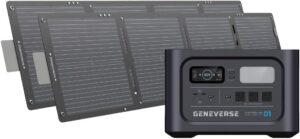

Key Features:
- Big 1260 Wh Capacity: One of the larger batteries under $1000 – can charge an iPhone ~100 times or run a 10W LED lamp for 100+ hours. Great for multi-day outages.
- 1000W Continuous Output: Can handle full-size fridge (cycles ~150-200W) easily, and run most kitchen appliances except the very high watt ones. 2000W surge helps with motor startups.
- Family-Friendly Design: Simple interface, one-button turn on. Geneverse markets it to even non-techy users for emergency preparedness.
- Complete Kit Option: Often sold with SolarPower 100W panels – the station has Anderson Powerpole and DC inputs for solar with MPPT, making solar charging efficient.
- Reliable Brand Service: Geneverse (Generark) offers good customer support and a 5-year warranty when registered, indicating confidence in product quality.
Description: Formerly known as Generark, Geneverse made waves with its HomePower ONE, a 1260 Wh, 1000 W portable power station tailored for home backup. It often retails for about $999 and is marketed as an easy emergency power solution. The HomePower ONE uses a lithium-ion (NMC) battery (rated ~800+ cycles) and weighs about 23 lbs – quite reasonable given it stores 1.26 kWh. It sports 3 AC outlets (110V, 1000W combined), 2 USB-C (18W), 2 USB-A, and a 12V car port, covering standard needs. This unit’s strength is simplicity and reliability: it promises “7 days of essential power” for a household – meaning it can keep basics running intermittently over a week (for example, charging phones, running a fridge a few hours a day, etc.). It comes with a strong emphasis on safety (it has 6 built-in protection modules) and has an optional SolarPower panels bundle to charge it from the sun. Recharging takes about 8 hours via AC or 12-15 hours via solar (with two 100W panels). While it lacks some advanced features (no app or UPS mode), the HomePower ONE’s large capacity and straightforward operation make it popular among those preparing for natural disasters or extended outages. It’s essentially a “just add solar” home backup kit in a box.
Anker 757 PowerHouse (1229Wh, 1500W)


Key Features:
- 1229Wh LFP Battery: 3000 cycles to 80% means this unit will last through countless uses – ideal for daily off-grid living or frequent outages.
- 1500W Inverter: High output allows use of kitchen appliances, space heaters (on low settings), and can power multiple devices at once without tripping (e.g., run a 700W coffee maker and a 200W TV simultaneously).
- Wheels & Handle: Despite its weight, the wheels and telescoping handle make moving it room-to-room or to the car much easier – a thoughtful touch for a ~45 lb battery.
- UPS Bypass: While not a true UPS, it does support pass-through charging (you can use devices while plugged into wall) and switches to battery in ~20ms – effectively working as backup power for electronics in a pinch.
- Industry-Leading Warranty: 5-year warranty shows Anker’s confidence; many competitors offer 2 years. This backs up the PowerHouse’s claim as a long-term investment.
Description: Anker’s 757 PowerHouse is a bit above the $1000 mark at MSRP ($1399), but it frequently dips to ~$999 during sales, so we’re including this high-capacity, high-output beast for the value it offers at that price. The Anker 757 packs a 1229 Wh LiFePO₄ battery (with phenomenal 3000+ cycle life) and a 1500 W inverter (surge 2400W), making it one of the most powerful units in this “budget high-capacity” class. At ~45 lbs, it’s on the heavier side – but Anker includes luggage-style wheels and an extending handle, so you can roll it like a suitcase. Port selection: 6 AC outlets (!), 2 USB-C (100W each), 4 USB-A, and a car socket. It’s basically an entire power strip worth of outputs. The 757 recharges in about 1.5 hours via AC (thanks to 1000W input) and supports up to 300W solar. One of Anker’s standout features is build durability – they claim the 757 has automotive-grade aluminum frame and internal components built to last 10 years, plus they give a 5-year full device warranty (longer than most). If you catch this around $1000, you’re getting a robust unit capable of home backup (it can easily run a microwave or toaster, for instance, something 1000W units struggle with) and heavy-duty outdoor use. It’s essentially a “premium” power station that sometimes slides into the budget of $1000, offering tremendous long-term value.
These are some of the best high-capacity portable power stations you can find at or under the $1000 mark, each with its own strengths. Whether you prioritize max output (Bluetti AC180, Anker 757), fastest recharging (EcoFlow Delta 2), or simple reliable backup (Jackery 1000, Geneverse HomePower), there’s an option here to keep your home and adventures powered without breaking the bank.