

When you need more hours of power, Jackery’s Explorer 500 steps up. It doubles the 300’s capacity to 518Wh and has a 500W inverter. This mid-range station is ideal for longer trips or powering bigger gear. According to industry reports, brands like Jackery and EcoFlow dominate this market segment, and the Explorer 500 is a solid offering in their lineup. With 518Wh, you’re holding over half a kilowatt-hour in your hands – enough to run several devices through the night.
How Long Can the Jackery 500 Run Your Gear? (Common Device Run-Times)
With 518Wh on tap, you can keep gear running for quite a while. For example: a smartphone (≈5-10W charge rate) could recharge roughly 50-100 times. A laptop (≈50W draw) might run 8-10 hours. Low-power LED lights (10W) could stay lit for 30-50 hours. A small mini-fridge (~50W average) might run 8-10 hours before needing a recharge. Even a 12V CPAP machine (30W) could run 15-20 hours. For camping, this means overnight and beyond for phones and lights. During a blackout, you could power a 60W lamp and a small router for 6-8 hours, or charge all family phones multiple times. To maximize run-time, turn off devices when not needed and use energy-efficient appliances.
Jackery Explorer 500 – Mid-Range Workhorse
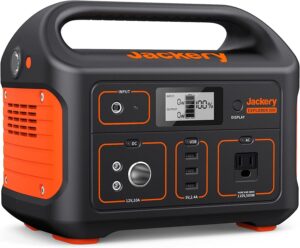

The Explorer 500 contains a 518Wh lithium-ion battery and a 500W pure-sine inverter. That means you have more than twice the energy of the 240 model and can handle longer run-times. It provides three 110V AC outlets, plus 2 USB-A ports and one USB-C PD port (65W). Charging is versatile: use the wall charger (about 7 hours to 80%), a car adapter, or a 5mm jack solar panel. Safety features include voltage/frequency regulation and an MPPT controller for efficient charging. It’s heavier (around 22 lbs) but still portable, with a sturdy handle. For off-grid use, this means you could run a CPAP machine overnight, charge multiple phones, and keep LED lights on all evening without draining it.
- Battery & Output: 518Wh capacity, 500W AC inverter (1000W surge).
- Ports: 3×AC outlets, 2×USB-A, 1×USB-C (65W PD), 1×12V car port.
- Recharge: AC wall charger (≈7h to 80%), solar or car.
- Durability: Internal BMS and quiet fans for reliability.
Jackery 500 vs Jackery 300/240 – Who Should Upgrade to the 500?
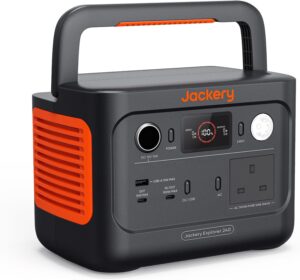

If you find the 300 or 240 just meeting your needs, the 500 makes sense. With 518Wh vs 293Wh, you get about 75% more energy than the 300. That translates to much longer run-time. For example, if your setup (lights, fan, phone) used 50W, the 300 would last ~6 hours, but the 500 lasts ~10 hours. The 500 also has more AC outlets and can run appliances that draw near 500W. In summary, upgrade to the 500 if you want more total power or need extra ports. If your usage is light (just phones and a couple of lights), the 300 or 240 might be enough. But for multiple gadgets or mid-size devices (mini-fridge, CPAP, etc.), the 500 is better.
Jackery Explorer 500 vs Goal Zero Yeti 500X – Mid-Range Battle
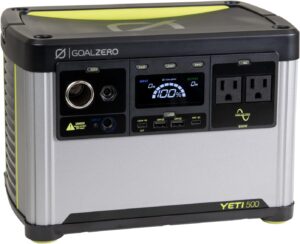

The main competitor to the Jackery 500 is Goal Zero’s Yeti 500X. The Yeti 500X has about 505Wh capacity and a 300W inverter (extending to 600W surge). It uses a lithium-ion battery. The Jackery 500 has a slightly higher 518Wh and 500W output vs Yeti’s 300W. Yeti’s 500X can power devices up to 300W, whereas Jackery handles 500W. However, Yeti’s six-diode UV LED flashlight and app connectivity add convenience. In practice, the Jackery 500 runs longer and handles heavier loads; the Yeti 500X is a bit smaller and has some extra features for camping. Both have multiple AC and USB ports.
- Jackery Explorer 500: 518Wh, 500W. Good for higher-draw appliances.
- Goal Zero Yeti 500X: ~505Wh, 300W (600W surge). Rugged design, includes a flashlight and car jump-start port.