

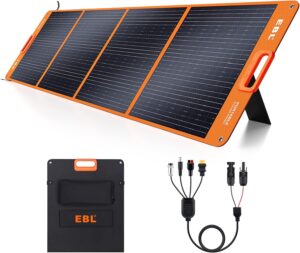

With many brands offering their own “solar generator” kits, it can be tough to decide which gives you the best value. Let’s compare a few top power station + solar panel bundles on the market, looking at what each includes and whether the price tag makes sense for what you get. We’ll consider factors like battery capacity, solar wattage, extra accessories, and unique features:
- Jackery Solar Generator 1000 vs 1500 vs 2000 Kits: – Jackery SG1000: Includes the Explorer 1000 (1002Wh NMC battery, 1000W inverter) plus two 100W SolarSaga panels (total 200W solar). Price range roughly $1,000-$1,200 on sale. What’s included: Power station, 2 panels, all cables (MC4-to-8mm adapters, Y-branch). Value: The Explorer 1000 alone often sells for ~$800; the SolarSaga 100W panels about $300 each. So separately you’d pay around $1,400. The kit’s bundled price often saves a couple hundred bucks and it’s a nicely balanced kit. 200W solar can charge that 1000Wh battery in a full day of sun, which is reasonable. It’s a popular mid-range choice (great for camping and small backup needs). Worth it if you want a proven plug-and-play kit with strong brand support (Jackery’s warranty is 2 years). – Jackery SG1500: (Actually called Explorer 1500 with panels – older model) – 1534Wh battery, 1800W inverter, typically bundled with 4×100W panels (400W solar). Costs around $2,000 when available. The Explorer 1500 unit alone is ~$1300; four panels would be $1,200 separately, so bundle at $2k is a good deal on paper. What’s included: The unit, 4 panels (that’s a lot), necessary branch cables. Thoughts: 400W input on a 1534Wh battery is great – charges in ~4 hours sun. But note, Jackery 1500 uses NMC cells (500 cycle life). The newer Jackery 2000 or 1000 have better tech (or LiFePO₄ on 1000 Pro). If price is similar, the SG2000 might be more future-proof. – Jackery SG2000 Pro: Explorer 2000 Pro (2160Wh, 2200W inverter) + 2×200W panels = 400W solar. Price ~$3,000 (often on sale a bit less). The station alone is ~$2,300, panels $600 combined, so bundle is near sum of parts; sometimes a slight discount. Included: Unit, 2 panels, adapters. Is it worth it? For serious backup, yes – it’s a high-performing kit, super fast AC charge (2 hrs) plus good solar. It’s expensive, but you get a lot. If you frequently need ~2kWh and high output, it’s a premium kit that has performed well for users (quiet home backup or basecamp power). If your budget allows, it’s a top-tier convenient kit.
- EcoFlow Solar Generator Kits (e.g., Delta 2 + 220W, Delta Max + 400W): – EcoFlow Delta 2 + 2×220W: (Like the one discussed above) – roughly $1,899 retail. Delta 2 alone $999, panels $549 each = ~$2,100 separate. So bundle saves a couple hundred. Includes: Delta 2 (1024Wh LFP), 2 folding 220W bifacial panels, cables. Value: Very strong. EcoFlow’s panels are pricey but high quality. The kit’s quick charge and expandability are big pluses. Many reviewers love how fast and easy it is. For ~1kWh capacity, it’s one of the best-balanced kits in terms of charge speed and output. If around $1.9k, it’s worth it vs similar Jackery 1000 kit which has older battery tech and lower inverter (if you need the extra oomph EcoFlow provides). – EcoFlow Delta Max (2000) + 4×160W panels: Some kits pair the 2016Wh Delta Max with 4x160W (640W) solar. Price was around $2,800. Delta Max unit $1,800 by itself, panels $300 each (x4=$1,200) so about break-even or slightly better in bundle. Includes: Unit (NCM battery ~800 cycle), 4 rigid or folding 160W panels, MC4 cables. Worth it? Possibly. The Delta Max can take 800W solar, so 640W is quite good to utilize it. It can even dual-charge with AC + solar. However, for similar money, Bluetti’s AC200 kit (LFP, 200W panel) or Jackery’s might lure some. The advantage is EcoFlow’s tech (fast charge, app). If you find a sale, it’s a solid big kit, but at list price there might be LiFePO₄ options to consider unless you need Delta Max’s unique features (like supporting their Smart Home Panel).
- BLUETTI Kits (AC200P/Max + panels): – BLUETTI AC200P + 3×PV200 (600W): This was a common bundle. AC200P (1700Wh LFP, 2000W inverter) + three 200W panels ~ $2,200 on sale. Individually, AC200P ~$1,300, panels $500 each ($1,500), total $2,800, so bundle saved ~$600. That’s significant. Includes: Station, 3 panels, all MC4 cables, perhaps a parallel connector. Value: High, given Bluetti’s panels are good and the AC200P is proven (though heavy). At that price (when available), it undercuts many rivals on a per Wh basis. This kit is heavy duty – 600W solar can charge that ~2kWh in ~4 hrs, and it can run a lot. It was a favorite for off-grid cabins. If you see a similar AC200MAX (newer model) bundle, those are excellent too – often AC200MAX + 3 PV200 for ~$2.5k. – BLUETTI EB3A + PV120 (small kit): For a smaller scale, Bluetti had combos like the EB3A (268Wh mini power station) with a 120W panel for ~$400. That’s a neat small emergency kit for keeping phones, small devices charged. It often basically throws the panel in at a big discount. If you just need a little solar generator for short outages or camping lights/phones, those mini kits are worth a look. Jackery and Anker have similar small kits (Explorer 300 + 100W panel, etc.). They typically save ~$50-100 vs separate, and super plug-n-play.
- Other Notables: – Goal Zero Yeti 1500X + Boulder 100 Briefcase: Pricey due to Goal Zero premium; around $2,400. Honestly, the panel wattage (100W) is too low for that battery size in my opinion. You’d want at least 3-4 of those panels. Goal Zero’s strength is modularity and build, but bundle value is meh unless heavily discounted. Better to buy the Yeti and add third-party panels in that case. – Anker 767 + 1×200W Solar: They have a bundle for their powerhouse 767 (2048Wh LFP, wheels) with a 200W panel ~ $2,500. That panel is probably not enough for 2kWh if you use heavily, but it’s a start. Anker’s panel is high quality. If that kit goes on sale (sometimes ~$2,100), it’s decent. At full price, the Jackery or Bluetti equivalent might give more panel wattage for same money.
Is the bundle worth the price? The answer often is “yes, if you plan to use solar a lot.” If you were going to buy a power station anyway and think you’ll add solar, getting the kit up front is wise. It ensures you’re ready to go and you likely pay less overall. However, if you’re in a situation where you might rarely use the panels, or you suspect you can scrounge up a cheaper DIY panel setup, then consider that. Also consider warranty: with bundles, often both items have same warranty period from purchase. If you buy panels later, they might have separate warranties.
Comparative insight: Jackery’s kits are known for premium build, ease, but relatively high cost per Wh. Bluetti tends to offer more bang for buck (bigger batteries, more panels for your money) but slightly bulkier systems. EcoFlow sits in between with very advanced tech and decent pricing. If you see a bundle that gives at least 1W of solar per Wh of battery (e.g., 2000Wh kit with ~2000W of panels, or 1000Wh with ~200W panels) that’s a very balanced ratio. Many kits are about 0.2 to 0.3W of solar per Wh of battery (like 2160Wh with 400W is ~0.18W/Wh), meaning it takes multiple days to charge if empty. That’s okay if usage is light or intermittent. If you want quicker solar charging, look for kits with a higher panel-to-battery ratio (Bluetti often does ~0.3, EcoFlow ~0.4 for Delta2 kit, Jackery ~0.18-0.2 on their big ones).
In conclusion, evaluate each kit on: – Capacity vs Solar: Will the included panels recharge the battery in a day or so? – Individual Component Prices: Are you actually saving money? – Extras: Do they throw in useful extras (light, carrying case, etc.)? – Your Use Case: If you need out-of-box readiness and trust the brand, bundles are generally worth it. If you like to tinker or find deals on panels, sometimes separate pieces could work but you shoulder the integration effort.
Often, the intangible benefit of a kit – one-stop solution – is worth a lot. As many say, the best solar generator is the one you actually use; a bundle makes it so easy to use that you’re more likely to deploy it and get your money’s worth.