

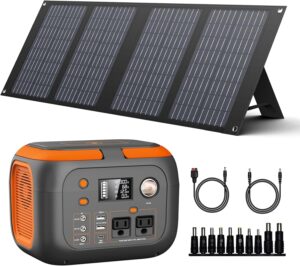

Hooking up solar panels to your portable power station is a fantastic way to stay powered off-grid. But to get the most out of your setup, you’ll want to use it efficiently. Solar, by nature, can be a bit fickle (clouds, angle of sun, etc.), so these tips will help you charge as quickly and reliably as possible:
- Position Panels for Maximum Sun Exposure: This is the big one – how you place your panels dramatically affects output. Angle the panels directly toward the sun. When the sun is low (morning/evening), prop the panels up nearly vertical. Midday, a flatter angle works. As a rule of thumb, the panel should be perpendicular to the sun’s rays for best results. If you’re stationary, adjust the tilt a couple of times a day – morning, midday, afternoon. Also, orient them facing the southern sky (in the Northern Hemisphere) or north (in Southern Hemisphere) to catch sun’s path. If you have multiple panels, consider using stands or a makeshift prop (even a rock or cooler) to get the best tilt. Every degree counts – a poorly angled panel might produce 50% or less of what it could. On the flip side, avoid shading on even a small part of a panel; a little shadow (from a tree branch or your RV’s antenna) can significantly cut output. Reposition away from shadows as the sun moves.
- Use the Solar Peak Hours Wisely: Solar charging is not linear throughout the day. The strongest output typically happens around solar noon (when the sun is highest). Depending on your latitude and season, roughly 10am – 2pm (or 9am – 3pm) are the prime charging hours with the highest intensity. Make sure your panels are out and positioned during these hours (it sounds obvious, but for example, if you’re hiking or away, at least leave the panels set up). If you have to move panels or only charge part of the day, prioritize that window. Also, if your power station is low, try to start the day with some capacity free so it can take all the solar input. If it’s already full or near full in the morning, you’re wasting potential harvest. Some people will run down their battery a bit in the early morning by using appliances (like making coffee) knowing they can replenish when sun gets strong.
- Keep Panels Cool and Clean: Solar panels work better when they’re cooler. A hot panel produces less voltage (hence less power). Obviously you can’t refrigerate your panels in the sun, but you can allow airflow behind them. Don’t lay them directly on a scorching hot surface – better to have them tilted with air flow. Also, wipe off dust or dirt. A thin film of dust can cut a few percent of output. Use a soft cloth and, if needed, a tiny bit of water to gently clean the panel surface (if it’s foldable fabric panels, just dusting them off is usually fine). If camping in dusty/sandy areas, cleaning panels daily can help.
- Use Longer Cables Judiciously: Sometimes you want to put panels in the sun while keeping the power station in the shade (which is wise to keep the battery cool). That often means using an extension cable. It’s fine to use MC4 extension cables or such, but note that longer cables can cause voltage drop (and some power loss). To mitigate that, use a decent gauge wire (thicker wire for longer runs to reduce resistance). If your run is under 20 feet, it’s usually negligible; for very long runs (50+ feet), expect some drop – maybe consider panels in series for higher voltage to push through the line (only if within spec). Also ensure all connectors are snug – any loose or corroded connection can create resistance.
- Monitor Charging and Adjust as Needed: Keep an eye on your power station’s input wattage reading (if it has one). This is your feedback. For example, if you expect ~200W from your panels and you’re only seeing 50W at noon, something’s off – maybe the angle is wrong or part of a panel is shaded. By monitoring, you can catch these things. If using an app (EcoFlow, Bluetti, etc. have apps), you might get real-time input data on your phone – convenient while you’re around camp. Also, watch how the input changes through the day – you’ll notice high input when sun is clear and direct, and dips when clouds pass. React to conditions: if a tree’s shadow starts creeping in at 4pm, maybe move the panel a few yards aside.
- Parallel vs Series for Partial Shading: If you have multiple panels and partial shading is inevitable (like occasional cloud or shadow on one panel), a parallel connection might be better. In parallel, one shaded panel won’t drag down the others as much (though overall current is reduced). In series, one shaded panel can act like a bottleneck for the string (unless bypass diodes mitigate it). Many folding panel kits (like a 200W kit composed of 2x100W in series) have bypass diodes per panel section to alleviate shading issues. If you notice that shade on a small section kills your output, you might reconfigure if possible. This is somewhat advanced, but worth noting.
- Over-paneling Strategy: This term means having more solar panel wattage than the max the power station can accept. For instance, you have 300W of panels but your station maxes at 200W input. In perfect sun, you won’t get more than 200W (the extra potential is wasted). However, in less-than-perfect sun (morning, afternoon, partly cloudy), having that overhead means you’re more likely to be hitting close to 200W whenever possible. Over-paneling can be useful in winter or cloudy climates where you rarely reach panel max anyway. Just ensure the voltage at open-circuit with all those panels doesn’t exceed the station’s limit. The MPPT controller will simply cap the input when it hits max. Many people do this to guarantee getting full input in marginal sun. It’s an efficiency tip – though it costs more (more panels), it can ensure your battery gets charged even in suboptimal conditions.
- Align Daily and Seasonal Patterns: The sun’s path varies. In winter, it’s lower in the sky; in summer, higher. Adjust your tilt seasonally if you have a fixed setup. If portable, just be aware winter sun gives fewer peak hours and needs panels more directly pointed. Also, if using daily, try to charge devices or use power when the sun is supplying it. For example, run heavier loads (like charging an e-bike or running a DC fridge) during the day when panels are active, rather than at night drawing solely from the battery. This concept is like using solar as pass-through power – effectively the panels are powering the load while also charging the battery or at least preventing discharge. It maximizes utilization of solar and saves battery for night.
- Temperature Effects on Battery Charging: If your power station is in cold weather, note that charging a very cold battery isn’t good (and BMS might block it under ~0°C). If you had it outside overnight in freezing temps, let it warm up a bit in the morning (perhaps via the sun indirectly, or keep it insulated). Conversely, keep the station itself out of direct sun heat while charging (maybe shade it behind the panels). This keeps the battery healthy and charging efficiently.
- Use MC4 Branches or Combiner Wisely: If you have multiple panels and want to combine them, use quality branch connectors. Keep wiring neat and avoid unnecessary connectors (each connection introduces some loss and potential failure point). If going parallel, branch early and use a single extension to the unit if possible, rather than long extensions for each panel then a branch right at the unit (to reduce wire length carrying high current). If in series, make sure connectors are firmly clicked – series voltages can be higher and any loose connection could arc or heat up.
In essence, be proactive with your solar setup – chase the sun (literally move panels as needed), keep your gear in good condition, and align your energy use with energy production when you can. With these practices, you’ll squeeze the most watt-hours into your power station each day. There’s a satisfying routine to it: morning coffee, put the panels out, adjust at lunch, check the watts, and by evening you’re powered up thanks to that big fusion reactor in the sky. Happy solar charging!