

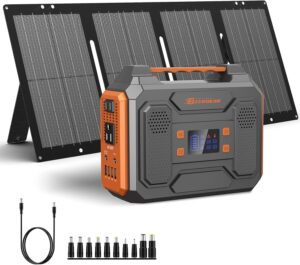

If you’ve been shopping around for portable power, you’ve likely seen the term “solar generator” used interchangeably with “portable power station.” It can be a bit confusing – are they the same thing or is there a real difference? Let’s clear that up in simple terms:
Portable Power Station (Standard): This refers to the battery unit itself – essentially a big rechargeable battery with an inverter and various outlets. Think of it as a silent electric generator that stores electricity. A standard power station can be charged from the wall (AC outlet), car DC socket, or even from solar panels. By itself, it’s just the power storage and output device. For example, a Jackery Explorer 1000 or EcoFlow Delta by themselves are portable power stations. They do not inherently include solar panels, but they usually have the capability to be charged via solar if you connect panels.
Solar Generator: This term is a bit of a marketing phrase; it usually means a portable power station bundled with solar panels or at least heavily emphasizing solar charging. It’s called a “generator” because with solar panels attached, it can “generate” power from the sun (as opposed to just storing power from an outlet). So, a solar generator isn’t a fundamentally different device – it’s basically a power station + solar panels working together. For instance, you might see “Solar Generator 1000” kit that includes an Explorer 1000 power station plus two 100W solar panels. Or a Goal Zero Yeti bundled with their Boulder solar panel briefcase. The combo allows you to both generate and store energy from solar, mimicking what a fuel generator does (but with sunlight as the “fuel”).
So, practically speaking, the hardware inside a “solar generator” power station and a standard power station is the same – both have batteries, inverters, charge controllers, etc. The difference is whether it’s packaged or used with solar panels:
- Charge Controller: One thing to note is that to effectively use solar panels, the power station needs an MPPT charge controller built-in (most quality ones have this). An MPPT (Maximum Power Point Tracking) controller optimizes the panel’s output to charge the battery efficiently. Almost all units marketed as “solar generators” will have MPPT, and nowadays even standard power stations include MPPT because they expect users may plug in solar. For example, the Bluetti and EcoFlow units have MPPT controllers to handle solar input out of the box.
- Included Accessories: A “solar generator” package will typically include solar panel cables, and sometimes the panels themselves, whereas a standard power station might just come with AC and car chargers. That means if you buy a stand-alone power station, you might have to buy solar panels separately – which is fine because it gives you choice. Solar generator kits are convenient because you know the panel and station are compatible in voltage/current, etc.
Use Case Differences: Standard power stations are often bought for their portability and as battery backups – you charge them from AC and take them on the go. Solar generators are targeting off-grid use: camping, RV, emergency home backup where grid power might be out for extended periods. If you have no grid, the solar panels allow you to continually recharge the station each day, essentially giving you renewable energy indefinitely (weather permitting). In marketing, a company might push the “solar generator” angle to highlight that it’s an eco-friendly alternative to a gas generator – no fumes, no noise, and free fuel from the sun.
Cost Consideration: Solar generator bundles cost more upfront because they include panels. Buying a power station alone is cheaper, and you can add panels later. Some people might already have solar panels or prefer a different brand/power of panel, so they go the modular route. Others, especially beginners, like the all-in-one kit – it’s straightforward, and you’re assured the components work seamlessly together.
Bottom Line: Think of it this way – every solar generator contains a power station, but not every power station comes with solar panels by default. When you read “solar-ready” or “solar capable” on a power station spec sheet, it means you can connect panels (sometimes the cables are included, sometimes not). When you read “solar generator,” they’re focusing on using it with solar. Some companies, like Goal Zero or Jackery, sometimes brand their kits as “Solar Generator [X]” where X might be the watt-hour or model, to indicate a kit.
Example: Jackery Explorer 2000 Pro (standard power station) vs. Jackery Solar Generator 2000 Pro (that same Explorer 2000 Pro plus 2× SolarSaga 200W panels). The latter is marketed as a solar generator kit. Internally, the Explorer 2000 Pro has an MPPT to take up to 600W of solar input, whether you buy panels from Jackery or elsewhere. The kit just gives you those panels in one package for convenience.
In summary, there’s no mysterious difference in function or technology – it’s mostly about whether panels are involved. If you want a full off-grid solution, you either buy a “solar generator” bundle or assemble your own by buying a power station and compatible solar panels. Once hooked up, you’ll be using the sun to keep your battery powered, which in turn powers your devices – that’s the solar generator life. No gasoline, no noise, just sun and a bit of strategy aligning panels toward the sky.