

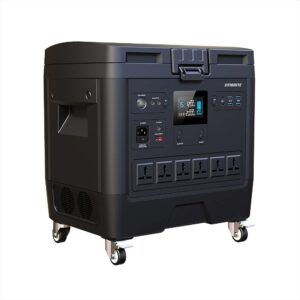

A 2,000Wh portable power station opens the door to powering serious appliances for significant lengths of time. Let’s break down some real-world examples of what ~2000 Wh (2 kWh) can do:
- Keep a Refrigerator Running: As mentioned, a typical home refrigerator consumes about 1 to 2 kWh per day. In practical terms, a fully-charged 2000Wh power station can run an average full-size fridge for roughly 10 to 20 hours. That covers an overnight outage easily, keeping your food cold and safe. During a longer blackout, you could ration power by plugging the fridge in for an hour at a time every few hours (since fridges cycle on/off) to stretch it over a day or two.
- Power Tools and Construction Gear: Many corded power tools (drills, circular saws, miter saws) draw around 800-1500W when in use. A 2kWh unit with a strong inverter can run a 1000W saw for about 2 hours of actual cutting time. In reality, power tools are used intermittently – a few minutes here and there – so 2kWh could easily support a day’s worth of DIY woodworking or construction tasks off-grid. For example, one user ran a miter saw (~1500W) plus other tools on the Bluetti 2kWh unit simultaneously, and it handled the startup surges around 4kW without tripping. It’s like having a nearly silent generator at a remote job site.
- Kitchen Appliances: You can cook or heat food using a power station of this size. A typical microwave might be ~1000W – you could run it for about 2 hours total (that’s a LOT of reheating and cooking, given most microwave tasks are minutes long). An electric kettle or hot plate drawing ~1200W could boil water or cook meals; 2kWh would allow roughly 1.5 hours of cumulative cooking time. In a pinch during a power outage, you can brew coffee, make hot soup, or even run an InstaPot or toaster oven for short periods.
- Home Electronics and Essentials: For lower-wattage devices, 2000Wh goes a long way. You can keep a few LED lights (let’s say 10W each) and a Wi-Fi router (10W) on for several days continuously. A 50-inch LED TV (around 100W) could theoretically run for 20 hours straight on 2kWh – enough for a full season binge of your favorite show during a camping trip. Laptop charging (60W) and phone charging are drops in the bucket for this big battery – you could charge a typical laptop ~30+ times or a smartphone 150+ times. Essentially, smaller gadgets barely dent 2,000Wh: it’s overkill for electronics, which is great news in emergencies.
- Medical Devices: If you rely on equipment like a CPAP machine (which often uses 30-60W), a 2kWh power station can run it for multiple nights. For example, at 40W consumption, 2000Wh would supply about 50 hours – roughly 6-7 full nights of sleep. This is a huge reassurance for anyone with medical needs off-grid or during blackouts.
- RV or Camping Use: In an RV, 2000Wh can run your 12V fridge, some lights, and device chargers for a couple of days. It could also power a small space heater or fan for a number of hours (though resistive heaters at 1500W will eat through the battery in just over an hour – so it’s more for short-term heating). For tailgating or camping luxury, you could bring an electric blender (300W), run a projector for movie night, or even an electric grill for a short barbecue – all from this one box.
Real-world tip: To estimate how long 2000Wh will last for a device, check the device’s wattage. Divide 2000 Wh by that wattage to get hours of run time (approximately). Keep in mind there are some energy losses (inverters are ~85-90% efficient). For example, a 100W bulb could run ~18 hours on 2000Wh (2000/100 = 20, minus a bit for inefficiency). In practice, mixing loads (fridge + lights + fans, etc.) totaling around 200W might get you roughly 8-10 hours.
In summary, a 2kWh power station is sizable enough to cover critical home appliances for many hours, or lighter devices for days. You can ride out most short outages comfortably – keeping food fresh, phones charged, and even enjoying some entertainment. During longer off-grid stints, you’d likely conserve power, but 2kWh gives a generous buffer. It’s this versatility that makes these large power stations so appealing: they can be a fridge-saver one day, a construction buddy the next, and the centerpiece of an off-grid movie night after that.