


When that sump pump motor kicks on, it’s like a mini electrical explosion – a sudden surge of power demand. If you’re considering a portable power station to keep your sump pump running in a blackout, one key question is: Can it handle the pump’s startup surge? Sump pumps, especially the more powerful ones, draw a lot more power in the second or two when they start than when they run continuously. This can be a deal-breaker for backup power sources. In this article, we’ll explain what that surge entails and what to look for in a portable power station to ensure it can handle the job. We’ll give you a straightforward guide, free of jargon, so you can feel confident selecting the right backup unit.
Contents
Understanding the “Surge” – Why Pumps Need Extra Juice to Start
A sump pump is driven by an electric motor. When an electric motor starts, it doesn’t have the benefit of momentum – it’s at a dead stop and has to overcome its own inertia and the initial resistance (like pushing water up a pipe from standstill). To do this, the motor briefly draws a higher current from the power source. This is called starting current or surge current, and it can be anywhere from 2 to 5 times the normal running current for a second or two. In terms of power (watts):
- A pump that runs at 600W might surge to ~1200W.
- A pump that runs at 1000W might surge to ~2000-2500W.
- A heavy-duty pump (like some 3/4 HP or 1 HP models) that runs at 1500W could surge to 3000W or more.
In many cases, the surge lasts only fractions of a second (the highest peak), and then a second or two at a slightly lower but still elevated level, before settling to the steady running wattage.
Think of it like starting to pedal a bike – the first push is hardest, then once you’re moving, it’s easier to keep going. The electrical “push” is the surge.
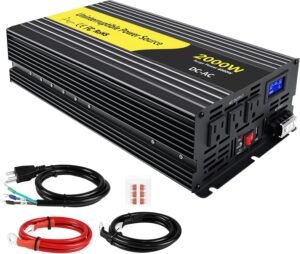
Now, why is this a problem for power stations? Because every power station’s inverter (the component that provides AC power) has limits. They’ll usually list two key specs: – Continuous Output (Watts) – what it can supply constantly. – Surge (Peak) Output (Watts) – what it can supply for a brief time (usually a few milliseconds up to a couple seconds).
For example, a power station might be rated 1000W continuous, 2000W surge. That means it can handle a short spike up to 2000W without tripping, but only momentarily.
If your pump tries to draw 2100W at startup and your power station maxes at 2000W surge, it may overload. Overload behavior differs by model: some will shut off output immediately (to protect themselves), some might attempt it and voltage will drop causing the pump not to start correctly (worst case: the pump motor just hums and overheats). Neither is good. You want the power station to supply that surge smoothly so the pump starts up normally.
Sizing Up Your Pump’s Needs
First step, identify your pump’s specs: – Look at the nameplate on the sump pump motor or the manual. It might list “Starting amps” or “Locked rotor amps (LRA)” which is essentially the surge current. For instance, it might say 10A running, 20A LRA. If it’s 120V AC, 20A corresponds to ~2400 watts surge (since Watts = Volts × Amps, so 120V × 20A). – If only the horsepower is listed, a rule of thumb: – 1/3 HP pump typically: ~800W running, ~1300-2000W surge. – 1/2 HP pump: ~1050W running, ~2000-4000W surge. – 3/4 HP pump: could be ~1500W running, surge 3000W+.
These are ballpark figures; actual can vary by efficiency and design. When in doubt, err on the high side for surge.
Another method: if you have the ability and want to measure, devices called “kill-a-watt” meters or clamp meters can sometimes capture peak amps, but many won’t catch the very rapid spike. Still, it can give a clue.
What to Look For in a Power Station’s Specs
Now translate that to power station shopping. Key spec: Surge (Peak) Wattage.
- Surge Rating >= Pump’s Surge Need: Ensure the power station’s peak output is comfortably above the pump’s startup watts. If you think your pump is ~2000W on startup, look for units with 2500W or higher surge. You want a margin, not just barely enough. For bigger pumps, that might mean only the larger power stations (with 3000W+ inverters) qualify.
- Continuous Rating >= Pump’s Running Watts: This is usually easier, since running watts are lower. But obviously, make sure, e.g., don’t try to run an 800W pump on a unit that only does 500W continuous.
- Inverter Quality: Not always in specs, but pure sine wave inverters are a must for motors (which most decent power stations have). Also, some inverters handle surge better than others. Check if the manufacturer specifies a time for surge (like “X watts for 0.1 sec, and 2/3 of that for 5 sec”, etc.). Ideally, the inverter can hold the surge for at least a half second or more. Motor surges aren’t just instantaneous; sometimes they need >1 second to settle. For instance, one might see “Max 3600W for <500ms, 2500W for 2s” in fine print. If possible, get user feedback – people often share on forums “Yes, unit X successfully starts my Y HP pump”.
- Battery Discharge Current Limits: This is less in the marketing, but worth noting: delivering a high surge draws a lot of current from the battery internally. Units with LFP batteries (LiFePO4) often can output high current without voltage drop because those batteries handle it well. Some older NMC-based units might have tighter current limits. The best bet is to stick with trusted brands/models that advertise appliance-running capability. If a power station brand explicitly mentions sump pumps or power tools in their use cases, that’s a good sign it’s built for surges. For example, EcoFlow and BLUETTI often highlight running AC units or pumps.
- Circuit Protection: Ensure the power station doesn’t have an internal fuse/breaker at a point lower than needed. For instance, some cheap inverters might have a 15A breaker (since typical wall outlet is 15A). That would trip at 1800W. But good power stations bypass that with electronic monitoring to allow surge above 15A for a moment. Again, big brand stations will handle it intelligently.
Real World Check: Examples
Let’s illustrate with a scenario: – Pump: 1/2 HP submersible, draws 10A running (~1200W), 30A locked rotor (~3600W). – Power Station A: Rated 1000W continuous, 2000W surge. This will likely fail to start that pump. 2000W < 3600W needed. The pump will try to start, the inverter will either shut off or the voltage will sag, pump might groan and not start. – Power Station B: Rated 1800W continuous, 3300W surge. Closer, but still slightly under the 3600W. It might or might not manage. Possibly not, because 3300W is just shy. Maybe if the pump’s actual surge is lower than nameplate (some pumps don’t hit full LRA if not under heavy load). It’s dicey. – Power Station C: Rated 2400W continuous, 5000W surge. This should handle it. 5000W surge covers the need with headroom. Indeed, EcoFlow, for example, advertises their units in this class specifically as being suitable for “the most demanding ½ hp sump pumps”. That’s the confidence you want.
Another example: – Pump: 1/3 HP pedestal pump (these often easier, say 600W run, 1200W surge). – Power Station: Even a 1000W/2000W could probably do this, since surge 1200W < 2000W rating. Many folks run 1/3 HP pumps on something like a Jackery 1000 without issues.
So, step one is know your pump, step two match with a station that clearly exceeds that.
Other Considerations for Surges: Inrush Current vs. Inverter Response
Sump pumps are an inductive load (motors), which have a high inrush current. A good inverter in a power station is designed to handle inductive loads. Some inverters are more geared to resistive loads (like toasters, lights) where surge isn’t as extreme. One clue: if a power station says it can power things like power tools, refrigerators, AC units – those are inductive loads and likely means its surge handling is robust.
Check if the manufacturer uses any terminology like: – “X milliseconds surge” or “peak power”. – UPS function with transfer time (not directly relevant but those with UPS often have to handle brief overloads). – Look for reviews or Q&A: people often ask “can this run a sump pump or fridge?” If the consensus is yes and no overload issues, that’s a good sign.
Also, note that temperature can affect performance. Inverters may output less if very hot. So if your power station is stored in a hot garage or basement that’s say 90°F in summer, it might derate slightly. Always good to keep it in a reasonably cool spot if expecting to push it near limits.
Matching Surge to Station – The Takeaway
In summary, yes, a portable power station can handle a sump pump’s power surge – but only if it’s the right unit with adequate surge capacity. Here’s what to do: – Calculate or find out your sump’s startup wattage (surge). – Choose a power station with a surge rating comfortably above that number. – Ideally, choose one that explicitly mentions high-surge appliances. – Don’t skimp; if in doubt, go to the next larger size. It’s better to overshoot than undershoot here.
It might feel like you’re buying a huge power station to run a relatively small 1/3 or 1/2 HP pump, but that’s the nature of the beast – it’s that intense few seconds that necessitate the overhead. The alternative is the power station trips and your pump doesn’t run right when you need it.
So, when shopping, make “Surge Watts” your primary filter for sump pump duty. If you see units touting things like “can handle 40A surge current for motor startup”, you’re on the right track. Once you have the right match, you can rest easy that when the sump pump float rises and calls for action, your backup power will deliver that crucial burst of power to get it spinning and save your basement from flooding.