

Utilizing the sun’s energy is one of the most freeing ways to keep your van life power station charged. Solar panels let you turn those sunny parking spots into a personal charging station. But how do you make the most of solar charging while on the move? Here are some practical tips and insights:
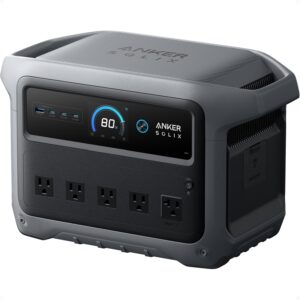

- Size Your Solar to Your Needs: A common guideline is that in decent sun, you get about 4-5 times a panel’s watt rating in watt-hours per day. For example, a 100W panel might produce roughly 300-600 Wh per day (0.3 to 0.6 kWh) depending on sunlight. If your daily usage is around 800 Wh, you’d want around 200-300 watts of solar panels to cover it. Many van lifers opt for at least 200W, often 300W or more if roof space allows.
- Panel Types – Portable vs Roof Mounted: Portable folding panels (suitcase or flexible panels you can set on the ground) are great because you can move them into direct sun even if your van is in shade. Roof-mounted panels, on the other hand, charge whenever sun hits the van – including while driving – without any setup effort. Some van-dwellers use a combination: roof panels for “always on” charging and an extra portable panel for when parked in shade or to angle toward the sun.
- Park Smart: If possible, park with your solar panels facing the southern sky (in the Northern Hemisphere) for maximum exposure. Think about the path of the sun – parking in an open area will yield much more energy than beside tall trees or buildings that cast shadows on your panels. In summer, the sun is high, so flat-mounted panels do fine; in winter, a tilt can help. Portable panels can be tilted easily – aim them roughly perpendicular to the sun’s rays for best results.
- Solar Charge Controllers: Most quality portable power stations have built-in MPPT charge controllers, which are very efficient at converting solar power to charge the battery. Just make sure the panel’s voltage is within the station’s accepted range (commonly ~10-25V for one panel, or higher if chaining panels). Many 100W panels put out around 18V open-circuit which is perfect. If you string panels, you might connect in parallel to keep voltage low (for example, two 100W 18V panels in parallel stay ~18V, whereas in series they’d be ~36V which might exceed some inputs).
- Managing Expectations: Solar is fantastic but remember its output varies. A panel rated 100W gives 100W only under perfect conditions (bright sun at noon, panel angle ideal, no heat or losses). In the real world, you might see 60-80W most of the day from a 100W panel, with peaks when conditions are just right. That’s why having a bit more panel wattage is helpful. Also, keep panels clean – a layer of dust can cut output noticeably. Wiping them with a soft cloth now and then (when they’re cool) helps.
- Driving and Solar: If you have roof panels and a pass-through charging system, you can actually charge while driving. This is great on road trips – you arrive with a full battery bank. Some power stations can charge from both solar and alternator (12V car outlet) simultaneously. Check your model; if it allows dual input, you could significantly speed up charging by using the car 12V (typically ~100W) plus solar at the same time.
- Mounting and Security: For roof panels, use proper mounting brackets or rack systems. Ensure everything is bolted down well since highway speeds can introduce strong wind forces. For portable panels, keep an eye on them – a sudden gust can tip them, or in public areas, you don’t want them to “walk away”. Some people use a light chain or cable lock to deter theft when panels are deployed at a campsite.
- Solar & Battery Chemistry: In colder weather, solar charging is a double win – panels actually work more efficiently in cooler temps (electronics like cooler panels), and you’re capturing limited winter sun. Just remember lithium batteries don’t like to be charged below freezing temps. If your battery is inside your van and above 32°F, no problem. Some advanced power stations have low-temp cutoffs or even internal heaters. If it’s very cold, you might need to warm the unit inside the cabin before charging.
- Monitor Your Input: Use the power station’s display or app to monitor how many watts the panels are putting in. This real-time feedback helps you adjust panel angle or location for best performance. It’s oddly satisfying to watch the wattage jump when you eliminate a shadow or tilt the panel a bit more into the sun!
By following these tips, you can maximize the free power raining down on your van. Many van lifers find that with sufficient solar and a good battery, they rarely need to plug in or fire up a gas generator. Your solar setup becomes an investment in ongoing, silent energy. There’s nothing quite like the feeling of independence when you brew your morning coffee entirely on yesterday’s sunshine.