
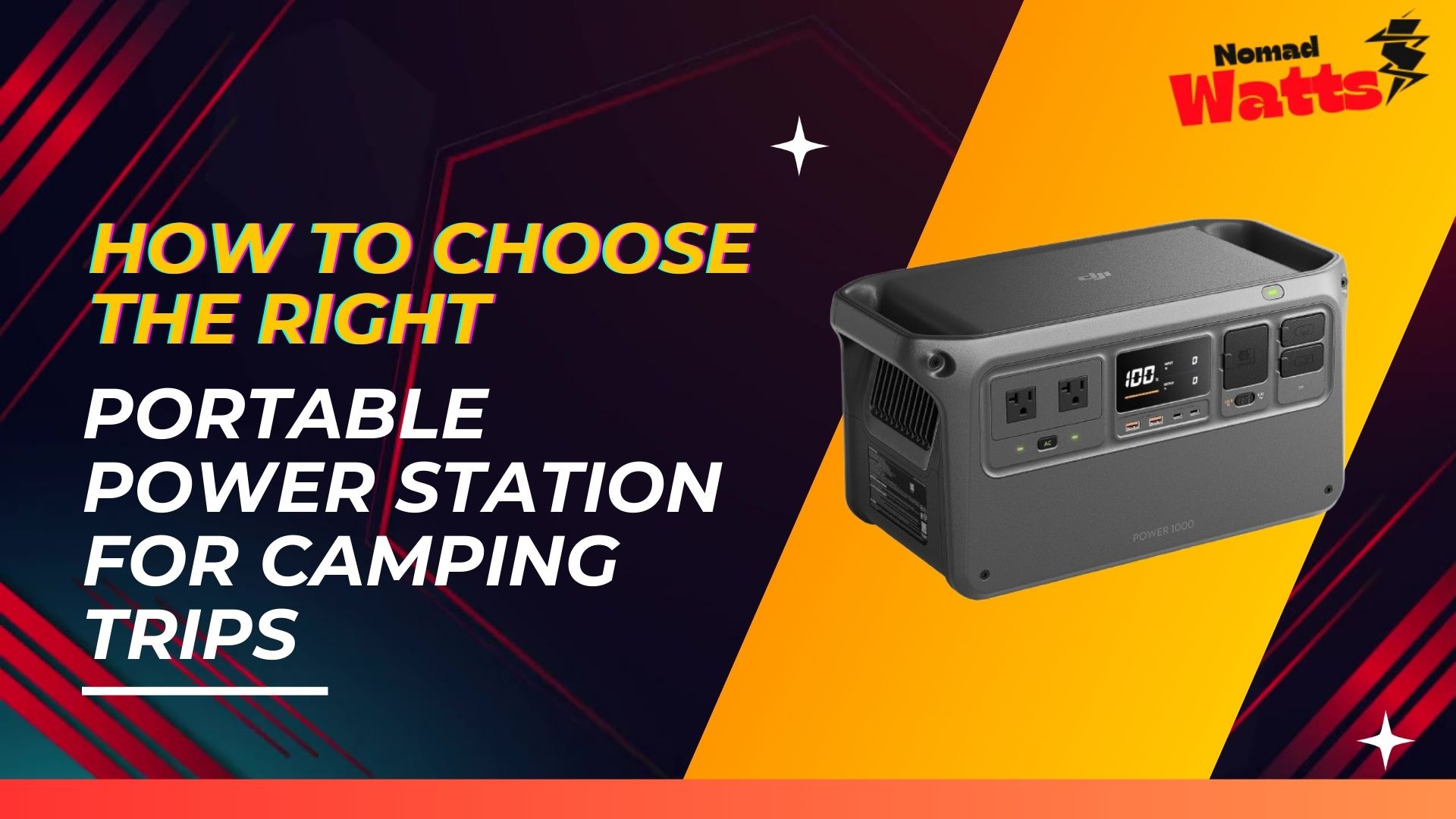


Picking the perfect portable power station starts with knowing what you need off-grid. First, think about your gadgets. Do you plan to charge phones and cameras, or run a mini-fridge and lights? The battery capacity (measured in watt-hours, Wh) determines how long the pack will last. For example, a 500 Wh station could recharge a smartphone dozens of times, but might only run a small appliance for an hour or two. It’s wise to “budget” the wattage: sum up the wattage of all your devices (a lamp might need 10 W, a mini-fridge 50 W, etc.) and estimate hours per day to see how many Wh you’ll use. As one RV guide notes, go for a model with capacity exceeding your expected needs so you have extra buffer.
Next, check the power output. This is the maximum wattage the inverter can provide continuously (and often the peak/surge power for startup bursts). If you want to run higher-draw gear (coffee makers, fans, TVs), pick a station with equal or higher output than those devices require. For instance, a space heater or portable air conditioner can need over 1,000 W – so a 500 W pack wouldn’t cut it. The RV.com guide explains that appliances like air conditioners or heaters have big startup surges, and your power station must handle those peaks or the appliance won’t run. In practice, I always choose a unit with output a bit above my highest-load device, just to be safe.
Port and socket variety is another key factor. Think about how you want to plug in: most stations have multiple AC outlets (often 2-4) that look like wall sockets. If you need to charge several things at once, more outlets is better. Also look for enough USB-A and USB-C ports for your phones, tablets and cameras. Many newer stations have USB-C (Power Delivery) ports that can fast-charge laptops at up to 100 W. A 12 V car outlet (cigarette lighter style) is handy for camping gear like portable fridges. As a rule, the more ports the merrier – but note that each extra port slightly increases the unit’s size and power draw. The RV guide notes that a big station might have 15-20 ports total, but in real camping you rarely plug in that many things at once. Prioritize the ports you’ll use most (e.g. make sure there are at least 2 USB-C PD if you carry modern gadgets).
How you’ll recharge it matters too. All stations can recharge from AC power (home wall outlet), which is usually fastest (often under 8 hours). They may also accept solar or car charger. If you camp without hookups, solar panels are a must. Check the station’s solar input rating (some handle 100 W, others 500 W or more). For example, some modern models can take 300 W+ of solar and fully refill in 4-6 hours of good sun. The RV guide mentions that with big panels you can sometimes charge faster from the sun than from AC. However, remember: more solar means extra gear (panels) to carry. If your campsite has 120 V power, you might rely on AC charging in the evening.
Weight and Portability are obvious for camping. A 2,000 Wh station might weigh 50+ lbs – fine if you’re car camping, but a burden if you hike. In general, smaller units (300-600 Wh) can be under 10 lbs; mid-range (1000-1500 Wh) often 20-30 lbs; big ones (2000+ Wh) can be 50+ lbs. Plan how far you’ll lug it. If you’re backpacking, you may want to look at ultralight chargers or power banks instead. For car camping, I ask: “How far from the car will I go?” If just around the campsite, a heavier station is okay. The RV guide sums it up: heavier units give more power but may stay inside the RV, whereas a small pack can go on hikes.
Consider the battery chemistry. Most stations today use lithium-ion or LiFePO₄ (lithium iron phosphate). LiFePO₄ is bulkier but much longer-lived and safer. If you plan to use it daily or for years, a LiFePO₄ unit (some jackery and Bluetti models) may retain capacity and life. For example, one station advertising LiFePO₄ offers 3,000+ cycles (>10 years of use). In contrast, Li-ion cells generally endure a few hundred cycles before fading. Also, LiFePO₄ is more tolerant of heat and has a lower fire risk (benefits at camp). So if budget allows, LiFePO₄ is a good choice for heavy users.
Other useful features: Charge speed (some have fast-charge tech to top up in 1-2 hours), stackability or parallel capability (to add extra batteries or link units for more power), and smart features like app monitoring. Some stations even offer a basic UPS mode to automatically keep devices on during sudden power dips, or built-in surge protection. While not essential for casual camping, these features add convenience. Finally, consider durability – a rugged build or water-resistance rating is a bonus in harsh outdoor conditions.
In short, match the station’s capacity and output to your gear, make sure it has the right ports, and balance that with weight you can carry. Always pick a little more capacity than you estimate needing, since nature can be unpredictable. By weighing these factors – battery size, power output, recharge options, ports and portability – you’ll find a camping power station that keeps everything running without carrying excess gear.