

Absolutely – a properly sized portable power station can run a refrigerator, but there are a couple of key requirements to get it right. The main considerations are the wattage (power) the fridge needs to start and run, and the battery capacity needed for the desired runtime. Most household refrigerators consume between 100 and 800 watts when running, depending on size and efficiency, and require 2-3 times that power momentarily at compressor startup. For example, a fridge drawing 400W running might need around 1200W for a second to kick on. Therefore, to run a refrigerator, your portable power station’s inverter must have a continuous output rating higher than the fridge’s running watts (plus some safety margin) and a surge or peak output at least equal to that 2-3× startup wattage. Additionally, the station’s battery (measured in watt-hours, Wh) determines how long it can run the fridge before recharging. In this section, we’ll break down the power requirements and give practical examples so you can confidently match a portable power unit to your refrigerator.

Running Watts vs. Starting Watts
Every refrigerator has two power ratings: running (or continuous) watts and starting (surge) watts. Running watts are what it uses during normal operation – for many modern fridges this might be around 150-300W for an average model, up to 700-800W for a large one. Starting watts refer to the brief spike when the compressor motor starts; this surge can be roughly 2-3 times the running wattage. For instance, a fridge that runs at 300W might spike to 900W or more for a second when the compressor kicks in.
Portable power stations must be sized to handle that surge. If your station’s inverter maxes out at 500W, it will likely fail to start a fridge that needs 900W at startup – the fridge simply won’t kick on. As a rule of thumb, choose a power station with an inverter rated for at least the fridge’s starting watts. If you’re unsure of your refrigerator’s exact surge, a safe approach is to assume 2.5× the running wattage. Many standard kitchen fridges (18-20 cu. ft. top-freezer models) run around 300-400W and surge ~1000-1200W. In that case, a power station with at least ~1000-1500W continuous output and 1200+W surge should work.
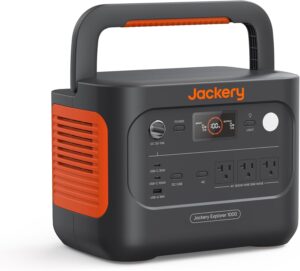
Example: The popular Jackery Explorer 1000 (1000W inverter, 2000W surge) can run a mini-fridge or small fridge, but might struggle with a full-size fridge’s surge. In contrast, the Jackery Explorer 1000 Plus has a 2000W inverter (4000W surge) and easily handles refrigerator startup. It’s always better to have some headroom.
Battery Capacity and Runtime
Having enough inverter power gets your fridge running, but how long it runs depends on battery capacity. Portable power station capacity is measured in watt-hours (Wh) – essentially how many watts it can supply for one hour (in theory). A fridge doesn’t draw power continuously; compressors cycle on and off through the day. Typically, a refrigerator’s compressor might run about 30-40% of the time under normal conditions (this is called its duty cycle). That means over an hour, the average power draw is lower than the running watt rating.
To estimate runtime, a simple formula (from a prepper guide) is useful:
Runtime (hours) ≈ (Power Station Capacity in Wh × 0.85) ÷ Refrigerator’s Average Wattage
The 0.85 factor accounts for inverter efficiency and some energy loss. The fridge’s average wattage takes into account it’s not running 100% of the time. For example, let’s say we have a 1500 Wh power station and a fridge that uses 400W when running but only runs 35% of the time (common for a full-size fridge). The average consumption is 400W × 0.35 = 140W. Plugging in: (1500 × 0.85) ÷ 140 ≈ 9.1 hours of runtime.
In real terms, around 9 hours from a 1500 Wh battery for that fridge. If the fridge runs more often (say it’s very hot out or you open it frequently), the average might be higher and runtime shorter.
Here are some ballpark figures for common scenarios:
- A mini-fridge (70W running, ~150W surge) – A 500 Wh power station (with ~300W inverter) can run it for ~6-8 hours. These fridges use little power; even some smaller stations can handle them.
- A standard kitchen fridge (~120W avg, ~1000W surge) – Needs a bigger inverter (≥1000W). A 1000 Wh battery might run it ~5-7 hours. A 2000 Wh station extends that to ~12-15 hours. For example, users report a ~1260 Wh Jackery 1000 Plus can keep an energy-efficient fridge going up to 18 hours (likely a smaller fridge).
- A large side-by-side or French-door fridge (avg 200W+, surge 1500-2000W) – Requires a heavy-duty station (≥1500-2000W output). To get 8+ hours runtime, you’d want 2000+ Wh capacity. Two 1000 Wh units chained, or one big 2500 Wh unit, would be suitable. For instance, the Bluetti AC300 with a 3072 Wh battery can run a 1500W appliance (like a space heater continuously, or a fridge cycling) for about 2 hours of actual running time – which for a fridge translates to roughly 6-8 hours of real clock time.
In summary, yes, a portable power station can run a refrigerator as long as you match the station to the fridge’s needs. Ensure the station’s inverter can handle the surge watts (often listed in the specs), and have enough watt-hour capacity for the duration you need. If you want overnight coverage for a big fridge, look at stations 1000 Wh and above. For shorter emergency use or mini-fridges, smaller units will do.
One more consideration: as the battery depletes, some power stations will shut off at 0%, obviously stopping the fridge. It’s wise to not run it completely to zero to avoid sudden cutoff. Some stations have an alert or percentage display – keep an eye on it and plan recharging if possible when it gets low.
Tips for Success
- Use a Station with 15-20% Extra Inverter Headroom: If your fridge is 700W running, don’t try to use a 700W inverter exactly at its limit. Go for 1000W or more so the inverter isn’t at max load continuously. This improves reliability. Anker’s guide recommends a unit with minimum output 2000W for a 1500W heater (similarly, ~600W for a 400W fridge).
- Keep the Fridge Full: A full fridge stays cold longer. If power is intermittent, full fridges coast through off-cycles better (use bottles of water or ice packs to fill space). That effectively reduces how often the compressor must cycle on battery.
- Limit Door Openings: Worth repeating – if the power’s out, treat the fridge like a cooler. Every opening lets cold air out and warm in, meaning the fridge will need to run sooner and use precious battery energy. Plan what you need, grab it quickly, and shut the door.
- Consider Fridge Type: Lower-power fridges (like modern Energy Star top-freezers or 12V RV fridges) are easier on power stations. Old fridges or those with freezers and ice makers draw more power. If your fridge is older or a power hog, you might need a larger station than someone with a new efficient model. Check your fridge’s spec label for amps or watts; it helps in choosing the right power station.
By understanding these power requirements, you can choose the right portable power station and confidently keep your refrigerator running. Many people successfully use battery generators for fridges during outages – just match the specs and you’re good to go!