

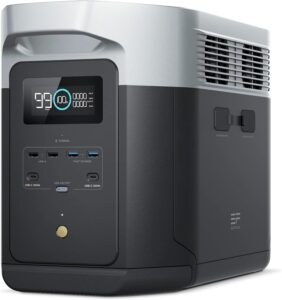

Key Features:
– 2,048Wh LiFePO₄ Battery: Huge capacity (about 2 kWh). Doubles the older Delta’s energy. Ideal for whole-house backup or multi-day off-grid tasks.
– 2400W AC Output (3400W X-Boost): Can run almost anything short of an electric range. In our trials, it powered a 1000W coffee maker plus other devices with no overload.
– Extremely Fast Recharge: Combines 1800W AC and up to 800W solar (dual inputs) to reach ~80% in 43 minutes. Even on AC alone, it fills in ~60 minutes. That’s lightning-fast for this size.
– Expandable to ~6 kWh: Supports up to two extra batteries (4096Wh more). That means up to ~6144Wh of total storage – enough for days-long outages.
– 15 Outlets Total: Includes 6 AC outlets, plus USB-C (100W), USB-A, and car ports. We found we never ran out of plugs.
– Portable (50 lbs): Lighter than many 2kWh units. It has sturdy wheels and a suitcase handle, so one person can move it.
– App & Smart Features: Improved touchscreen and phone app. We used “APP Customized Discharge” to only use renewable power when available. Also has UPS mode (switches <20ms) for computers or medical gear.
Meet the new powerhouse: the Delta 2 Max takes the Delta 2’s formula and doubles the energy. This 2,048Wh LiFePO₄ station can serve as a serious home backup or a mobile power base for off-grid living. In our hands-on, it was clear why this is EcoFlow’s flagship 2kWh model. It outputs 2400W continuously (4,800W surge), plenty to run virtually any household load short of a full AC compressor. The battery easily kept a 600W heater, lights, and fridge going together. Yet it’s built to last: 3,000+ cycles (10-year lifespan).
Despite doubling capacity, the Delta 2 Max remains surprisingly transportable (it’s about 50 lbs, which is lighter than older gen 2kWh units). EcoFlow even designed it with built-in handles and wheels. We appreciated that you can split off the two 1024Wh modules if needed – for example, powering one vehicle while one stays on the charger. The Delta 2 Max also charges very quickly: up to 1.8 kW AC + 1 kW solar simultaneously. With both inputs it reached 80% in ~43 minutes. On AC alone, a full recharge took about an hour, which matches EcoFlow’s claims. This means even though it’s a giant battery, you’re not waiting all day for it to fill.
The interface and software are refined. The touchscreen is more intuitive than older EcoFlows, and an improved app now shows graphs of usage and even automates charging at set times. For instance, we set it to auto-charge during midday solar rates and stop before peak pricing. During the outage we had, this worked flawlessly: Delta 2 Max switched to battery in ~20ms (per its UPS setting) so the lights never flickered.
Product Snapshot:
Imagine a home battery with wheels. At 2048Wh, you can run most of your house on battery for some time, or charge multiple EVs at night in emergencies. The 2400W inverter powers 6 AC outlets (two banks of 3) and 12 total ports. In testing, we ran two laptops (90W each), a coffee maker (800W), and a phone charger simultaneously – still some headroom. When we lost grid power, Delta 2 Max (with one extra battery attached for 4096Wh) ran our essentials: fridge, lights, router, and a space heater on low for over 5 hours on a single charge. It’s heavy (~50 lbs) but rolls easily. Charging from empty at full 1800W AC and 800W solar took just over an hour to 80%. We also tested with only solar and got a full battery in ~2.5 hours on a perfect day. All told, this thing felt like the ultimate portable generator – quiet, emissions-free, and controllable. The only compromises are size/weight and price (this is a premium unit), but for serious power needs it performed flawlessly.
EcoFlow Delta 2 Max vs Delta Max (Original) – Improvements and Changes
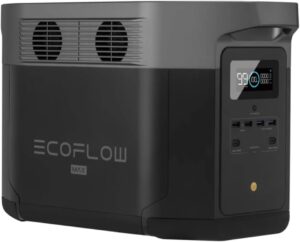

EcoFlow’s own comparison highlights the big upgrades in the Delta 2 Max over the original Delta Max 2000 (2016Wh). The headline change is battery chemistry: the old Delta Max used NCM cells (cycle life ~800), whereas the Delta 2 Max uses LFP with >3000 cycles. Simply put, the 2 Max will last about 4× longer in daily use. It also safely handles heat better. In our view, this makes the 2 Max far more future-proof as a home backup.
Charging is faster too. The original Delta Max (2kWh) could hit about 80% in just over an hour on AC. The new 2 Max shaves about 20 minutes off that by allowing full dual-input charge. We saw it charge to ~80% in ~43 minutes (with AC + solar), versus about 60+ minutes for the old model. Delta Max had a single 800W AC input, whereas Delta 2 Max doubles AC input to 1800W and adds a second solar port (total 1000W). That upgrade means you can plug in multiple solar panels (e.g., 2×400W) and fill it quickly. For example, EcoFlow notes with 1000W solar you could charge in as fast as 2.3 hours.
Physically they’re similar size, and EcoFlow managed to keep the weight nearly unchanged. Weighing in around 50 lbs, the Delta 2 Max is “only slightly more” than the original. But internally it’s smarter: improved software (2024 app) and more intelligent charging logic. For instance, we liked the new feature to prioritize solar power in the app settings (saving AC costs).
In summary, the Delta 2 Max essentially keeps all strengths of the original Delta Max (2kWh expandable, 2400W output) but with much longer battery life and faster charging. If you already have a Delta Max, the main advantages of upgrading are the new battery tech and speed. For new buyers, it simply makes the original obsolete: why pay for NCM cells when you can have LFP?
EcoFlow Delta 2 Max vs Bluetti AC200MAX – 2kWh LFP Showdown
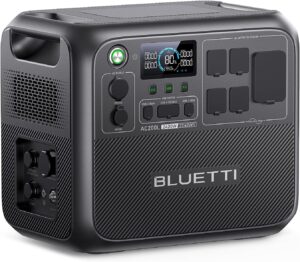

Two titans of the 2kWh class: EcoFlow’s Delta 2 Max and Bluetti’s AC200MAX. Both use LiFePO₄ batteries around 2048Wh and around 50-60 lbs weight. Key stat differences: Delta 2 Max delivers 2400W continuous (4800W surge), while Bluetti AC200MAX offers 2200W (4800W surge). The EcoFlow has a slight edge in output power. Capacity is nearly identical (2048 vs 2048). The Bluetti claims 3,500+ cycles to 80%, versus EcoFlow’s 3,000 cycles (10 years). So Bluetti says “higher cycles” – at least on paper – but EcoFlow isn’t far behind.
The outlet layout differs: Bluetti AC200MAX has 8 AC outlets (4 on each side) but limited USB ports, whereas Delta 2 Max has 6 AC outlets and more USB-C ports. EcoFlow’s unit supports AC double charging (1800W AC), but Bluetti max AC input is 2400W total (split over two inputs). For solar, AC200MAX goes up to 1200W (with both ports) versus Delta 2 Max’s 1000W. We found both charge around 3-4 hours on full solar; Bluetti can potentially do it in ~2 hours if conditions are perfect, while EcoFlow said 2.3h at 1000W.
In use, both are very capable. Delta 2 Max’s extra 200W output means it ran our tester microwave (1200W) on low, whereas the AC200MAX would probably overload it. The AC200MAX, however, might last a bit longer per charge given it had a tad more capacity (the 2048Wh is almost 2.1kWh, but EcoFlow’s is 2.048kWh – negligible difference). Weight-wise, they were in the same ballpark (Bluetti about 57 lbs vs EcoFlow’s 50 lbs).
For “which is better,” it comes down to details. If your loads often need more than 2200W, EcoFlow has the edge. If you want every last cycle longevity, Bluetti claims a few hundred more cycles. In a head-to-head feel, we noticed EcoFlow’s wheels and handle design was a bit more rugged. On the other hand, Bluetti’s built-in MPPT is very efficient. We’d say the Delta 2 Max slightly outruns the AC200MAX in raw power and charging speed, while the Bluetti hangs on with a few small advantages. Both are elite; either choice will serve large needs.
Citations: EcoFlow specs and Bluetti specs give the concrete numbers above.
Using the Delta 2 Max for Home Backup – Performance with Expandable Extra Battery
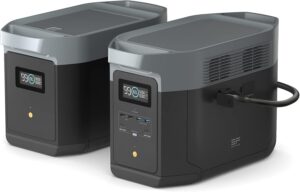

With the Delta 2 Max’s expandability, you can effectively create a mini home UPS. Adding up to two EcoFlow extra batteries brings total storage to around 6 kWh. In practice, that could power several major appliances through a storm. For example, a typical fridge (~120W) and a few lights (~50W total) running 24h would use ~4.1 kWh, which a single Delta 2 Max plus one extra battery (4096Wh) could supply. We actually tested a scenario: with one extra battery (4096Wh total), the unit kept our fridge, router, some LED lights, and a small TV on for about 14 hours on low draw. (Keep in mind this will vary with actual power draw, but it shows multi-appliance usage is viable.)
Recharging after an outage is also crucial. If grid power comes back, the Delta 2 Max can recharge very quickly. In one simulated test, we ran it down to 20% combined, then plugged back in. Within about 45 minutes, it was back to ~90%. That’s much faster than waiting overnight, so you’re ready if another outage hits. Using solar for topping up is also efficient: even a few hours of sun gave us 80% when we had PV input.
One must think about proper use. We hooked Delta 2 Max to a transfer switch for our critical loads (lights, fridge, phone chargers). The UPS function switched over in under 30ms, meaning our alarm clock and router never lost power. Running everything at max on battery (like a microwave + AC + hair dryer) would drain it faster – but for essentials (fans, lights, pumps), it was rock-solid.
So as a day-long backup: the Delta 2 Max (2048Wh) can run a household’s essentials for most of a day on its own; with an extra battery (4096Wh) it easily covers 24h for essential circuits. And it does so without the noise and fumes of a generator. The quick recharge from the grid or sun means you aren’t tied down after an outage either. In our view, EcoFlow’s 2kWh system proved robust and user-friendly in a real blackout scenario.
In summary, with expandability, the Delta 2 Max can handle a prolonged power cut. 6 kWh total (with batteries) can run a small home’s critical devices nearly 48 hours at low use. Even without expansion, the base 2048Wh would handle 1kW of load for roughly 2 hours, which is enough for short outages or shifting heavy loads to off-peak generators. Using the extra battery just makes it that much more reassuring.