

In a Nutshell – Solix F3800 Features:
- Huge 3840Wh LFP Battery: Built to last with thousands of cycles.
- 6,000W AC Inverter: Runs large appliances (air conditioners, well pumps, etc.).
- 2400W Max AC Input: Recharge 0-100% in ~2 hours with high-speed wall charging.
- 2400W Solar Input: Up to 2400W solar charging (1200W on each of two MPPT channels).
- Expandable to 6 Batteries: Up to ~23,000Wh total with six expansions (26.9kWh).
- Split-Phase (120V/240V) Output: Can power 120V and 240V circuits at once.
- Mobile Design: Integrated wheels/handle to move its 132-lb bulk.
- UPS & Whole-Home Ready: Can link to home transfer switch for seamless outage backup.
The Anker Solix F3800 (Fusion) is a beast of a home backup battery, offering 3,840Wh of power with a 6,000W inverter (in U.S. model). That means it can run most household appliances simultaneously for a long time. To set the scene: as climate events cause more blackouts, robust home systems are growing in demand. Surveys show 84% of Americans worry about blackouts, yet only 15% have backup power – systems like the F3800 aim to close that gap.
The F3800 is like a mobile micro-generator. It uses LiFePO4 batteries for longevity (also 3,000+ cycles) and can recharge very quickly. Plugged into 2400W wall power (split-phase), it tops off from empty in only about 2 hours. With up to 2400W solar input, it can charge in similar time using panels. The unit itself is large (about 132 lb/60kg) and has wheels and a handle, so you can roll it around. Its dimensions are roughly 16 × 18 × 22 inches, so plan a storage spot in your garage or utility closet.
Anker Solix F3800 vs EcoFlow Delta Pro 3 – Ultra High-Capacity Comparison
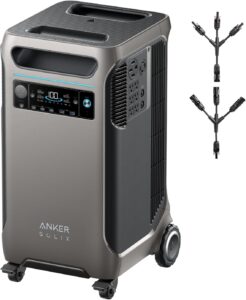

The EcoFlow Delta Pro 3 is a strong rival with 4096Wh of battery and a 4000W inverter (peak 8000W). Compared side-by-side, each has its strengths. The Delta Pro 3 has slightly more energy storage (4096Wh vs 3840Wh), but the F3800’s inverter is far beefier (6000W vs 4000W). That means F3800 can handle higher continuous loads (up to 6kW) – useful for things like air conditioners or high-power tools.
Both units support split-phase 240V output. The F3800 can supply 120V and 240V at the same time, effectively powering two separate panels of home circuits. The Delta Pro 3 also supports 120/240V but only one at a time. In practice, the F3800’s extra inverter power can run nearly any 120V or 240V appliance concurrently.
Solar/charging is similar: DP3 accepts up to 2600W solar, F3800 up to 2400W. Note EcoFlow’s inputs are compatible with its 10A Fusion panels, but F3800 may need a slight adjustment (using XT60/Anderson, etc.) depending on panels. As for expandability, the F3800 wins big – it allows up to 6 expansion batteries (~23.0kWh total), versus only 2 for the Delta Pro 3. Both can be stacked with EV car battery packs, but F3800’s design is already bulkier (132 lb vs 103 lb for EcoFlow).
In summary, if raw inverter power and expandability are your priority, the F3800 leads: 6000W output and room for six batteries. The Delta Pro 3 has a little more base storage (4096Wh) and slightly faster 2600W solar in, but fewer expansion slots. Both are modern, high-capacity systems for serious power needs.
Who Needs a 3840Wh Power Station? Use Cases for the Anker F3800
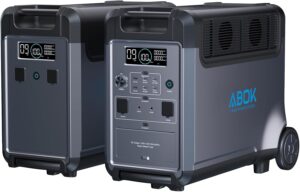

The Solix F3800 is aimed at very heavy-duty needs. Think of anyone wanting multi-day backup for a whole house or off-grid setup. Here are some real-life situations:
- Home Backup: With 6000W output, the F3800 can run major appliances during an outage. For example, it can power a home’s furnace, air conditioner, or water heater when the grid fails. It can keep lights, fridge, and medical devices (like CPAP machines) on for hours at high load. Anker notes it can recharge from solar/AC in ~2 hours, so you could even use it daily and top it up during daylight.
- Off-Grid Living: Remote homes or cabins without grid power benefit hugely. The F3800’s nearly 4kWh capacity (expandable to ~26.9kWh) allows running TVs, computers, and appliances all day. Its split-phase output even supports 240V devices (e.g. electric stove, well pumps). Users who live in tiny homes or have DC appliances (fridge, router, lights) can wire them to it.
- RV and Camping: It’s big for RV use, but for long trips with high power needs it works. The F3800 has wheels/handles making it more portable than a bulky generator. You could run rooftop A/C units, induction cooktops, or even an electric winch. It’s like hauling a big battery bank with you. For short camping trips it’s overkill, but for extended stays or van life in cold weather it shines.
- Job Sites/Events: For powering tools or event gear in places without reliable power. Contractors running heavy tools (welders, compressors) might use it along with solar panels, avoiding noisy gas generators.
- Emergency Services: In disaster zones, responders can use it to charge comm gear, run medical coolers, and coordinate relief without fumes or noise.
In all these cases, users praise the F3800’s large 6000W output and fast recharge. Anker even markets it as an alternative to small gas generators for homes. For example, a review notes it “powers air conditioners, water heaters, well pumps, refrigerators” – basically most home loads. The built-in wheels and handles make hauling this 132-lb unit much easier.
So, if you’re asking “Who needs nearly 4kWh of portable power?”, the answer is anyone who can’t risk losing electricity for critical needs. That could be families in storm-prone areas, off-grid homesteaders, or pros with big tools. In exchange for its size, the F3800 delivers flexibility: you can roll it into your garage one day, attach home circuits, and run your lights and fridge seamlessly.
Managing the Anker F3800’s Weight and Size – Tips for Portability and Storage
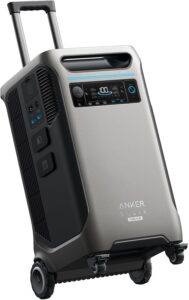

Here are some tips:
– Use its wheels: Always use the wheels/handle to roll it. Lifting should be a last resort.
– Transport carefully: If you must load it into a vehicle, let two people carry it or use a sturdy cart. Mind the clearance – its dimensions (~16×18×22 inches)mean it needs a fair amount of space.
– Store safely: When not in use, store the F3800 in a dry, climate-controlled place to protect the battery. A garage or basement shelf works, as long as it’s out of direct sun and above freezing.
– Leave it charged: For longer storage, keep it at least 50% charged per Anker’s advice to maintain battery health.
– Keep vents clear: Make sure ventilation slots aren’t blocked if the unit is in use. Overheating could be a concern given its power rating.
– Consider environment: Its IP rating is not waterproof, so avoid leaving it out in rain.
Yes, the F3800 is heavy. It tips the scale around 60 kg (132.3 lbs). You’ll almost certainly need two people to lift it. Fortunately, Anker built it with mobility in mind. It has integrated wheels and a retractable handle that make it more like rolling luggage than a fixed box. When you need to move it (say from garage to backyard solar array), simply tilt it onto its wheels and pull.
In short, treat the F3800 more like luggage on wheels than a backpack. With the wheel kit, it’s surprisingly easy to relocate for an RV trip or around the yard. Many owners simply leave it rolled up by their home’s transfer switch or solar panel array when deployed. The effort is worth it: in emergencies it might be the only thing keeping your lights on, and when camping, it’s a silent heavy-duty generator substitute.