

Think of a small box that keeps your phone, camera, or mini-fridge running through a weekend without power. That’s the Jackery Explorer 240. It’s a lightweight powerhouse for campers and emergency kits. Jackery is a trusted name (over 3 million units sold worldwide). In fact, the global market for these stations hit about $603 million in 2024 – proof that lots of people buy them. The Explorer 240 is one of Jackery’s best-sellers thanks to its balance of size and capability.
User Tips for the Jackery 240 (Maximizing the 200W Limit)
To get the most out of the Explorer 240, keep these tips in mind: First, stay under 200W load. The unit will automatically shut off if you exceed 200W. Don’t plug in a heater or other high-watt device above that. Second, cycle the battery occasionally. It’s okay to run it down, but try not to leave it at 0% for long. On the flip side, if you store the Jackery long-term, keep it around 50% charged and in a cool, dry place. Third, use the USB ports for small devices (phones, lights). Those draw little power and you’ll get many charges. Lastly, know the run-times: a typical smartphone might charge 20-30 times, or a laptop (~50W draw) could run 3-4 hours on a full 240Wh. Using devices wisely will stretch that 240Wh for as long as possible.
Jackery Explorer 240 – Compact Power House
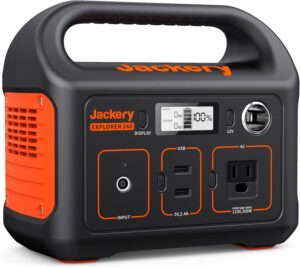

The Jackery Explorer 240 packs a 240Wh Li-ion battery and a 200W pure-sine AC inverter. In real terms, that means it can run a 40W device for about 6 hours. It has one AC outlet (110V) for lamps or a laptop charger, plus two 5V USB ports for phones/tablets and a 12V car-style port. It can even surge to 400W briefly to handle startup spikes. Weighing around 6.6 lbs, it’s easy to carry by its handle. You recharge it via the wall outlet in about 7 hours, or with solar panels in roughly 6-8 hours. Jackery designed it with safety in mind – the output is a clean sine wave, good for sensitive electronics.
- Battery & Output: 240Wh capacity, 200W AC inverter (400W peak).
- Ports: 1 AC outlet (110V pure sine wave), 2 USB-A, 1 DC car port.
- Design: Compact (22 x 13 x 9 cm), ~6.6 lbs with built-in handle.
- Recharge: AC charger (7-8 hrs), or solar panel (6-8 hrs, sold separately).
Jackery 240 vs Jackery 300 – Which Small Jackery Suits Your Needs?
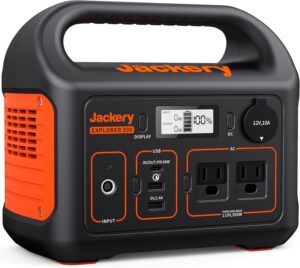

The 240 is the smaller sibling of the 300. The Explorer 300 has 293Wh battery and a 300W inverter, so it offers about 20% more running capacity and can handle slightly higher loads. In practical terms, the 300 can run a 60W appliance a bit longer than the 240. However, the 240 is lighter and costs less. Choose the 300 if you need the extra power or want longer runtime for laptops or fridges; go with the 240 for lighter travel and basic camping gear.
Jackery 240 vs Rockpals – Budget Power Showdown
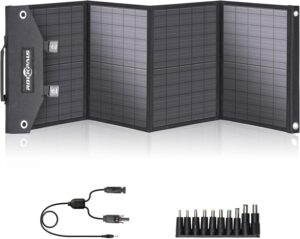

There are cheaper stations similar to the 240. For example, Rockpals sells a ~300W/300Wh model at a lower price. It offers about the same outlets, but often uses a lithium-polymer battery (not LiFePO₄). The Jackery has slightly cleaner output and Jackery’s build quality. If budget is tight, Rockpals can do the job for charging phones and lights. But Jackery usually has better safety features and a longer warranty. In general, Jackery’s 240Wh model is more reliable, while Rockpals appeals to thrifty buyers who can accept shorter warranty and service.