

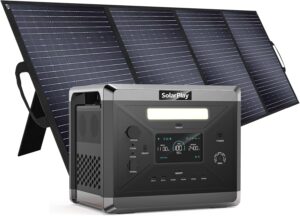

Buying a 2kWh power station is a significant investment, so it pays (literally) to take good care of it. With proper maintenance, these big battery units can last for many years – often a decade or more. Here are some tips on how to store and maintain your large portable power station for longevity and performance:
- Avoid Letting it Sit at 0% or 100% for Too Long: Lithium batteries (whether NMC or LiFePO₄) age best when kept around a middle state of charge, especially during storage. If you fully discharge your power station, don’t leave it empty for long. Likewise, it’s not ideal to store it at 100% for months on end. A good rule of thumb is to store around 50-60% charge for long-term periods of disuse. Why? Because cells kept at extreme high or low charge experience more stress and capacity loss over time. In fact, one source notes that storing a lithium battery at 100% charge could lose about 20% of its capacity in a year, whereas storing at ~40% charge might only lose ~4%. That’s a big difference! So, if you’re putting the power station away for the season, discharge or charge it to around half, then shelf it.
- Top Up the Charge Every 3-6 Months: Even when not in use, batteries will self-discharge slowly. It’s wise to plug in your power station every few months to ensure it doesn’t drift down to empty while sitting. Many manufacturers advise a recharge cycle at least every 3 months. For example, Jackery recommends charging their units to full, then not letting them go below, say, 20% for long periods – and definitely not leaving them completely drained for more than a few months. Regularly “exercising” the battery with a charge helps keep it healthy. Set a reminder quarterly to check the charge level; if it’s dropped significantly (e.g. from 50% to 30%), top it back up to 50-60%.
- Store in a Cool, Dry Place: Heat is the enemy of lithium batteries. High temperatures accelerate chemical aging. So avoid storing your power station in a hot garage or car trunk, especially in summer. Ideal storage temperature is often around 50-77°F (10-25°C). At the very least, keep it out of direct sunlight and away from heat sources or extreme cold. A dry indoor closet or basement (that stays temperate) is great. Also ensure it’s not in a damp area – moisture and electronics don’t mix. Some units are fairly robust, but humidity can still creep in and cause corrosion over long periods. Quick note on cold: most lithium batteries won’t charge below freezing temps (the BMS will usually prevent it). They can discharge in the cold, but with reduced efficiency. So, for winter storage in an unheated shed, consider bringing the unit inside to a conditioned space to be safe.
- Mind the Operating Temperatures: When using the power station, try to keep it within recommended temperature ranges (often 32°F-104°F for operation). In practical terms, don’t leave it baking in the sun or running in an enclosed hot space. If using it outdoors on a hot day, keep it in the shade. In cold weather, you might keep the unit off the ground (which could be much colder) or in a insulated cooler (without ice!) to keep it from freezing too much. Some advanced models have built-in heaters for the battery or at least low-temp charge protection. But as a user, preventing extreme temps is the simplest approach.
- Clean the Ports and Fans: Every now and then, especially if you use the power station in dusty or outdoor environments, inspect the AC outlets, DC ports, and cooling fan vents. Dust buildup can impede cooling or make for poor electrical connections. You can use compressed air to gently blow out vents and ports. Make sure it’s powered off and unplugged when cleaning. For the exterior, a soft dry cloth or lightly damp cloth can wipe away grime. Don’t use harsh chemicals.
- Cycle It – But Not Excessively: It’s actually good to use your power station periodically. Let it discharge under a reasonable load and then charge it back up. This helps calibrate the battery management system’s reading of capacity and keeps the cells active. However, you don’t need to deep-cycle it constantly just for fun – remember, lithium cells have finite cycle lives (even LiFePO₄, albeit very high). Normal use is fine. If you’re only using it for emergencies, perhaps do a test run every 6 months: power some devices for a while and recharge, to ensure everything’s working and to give it a little exercise.
- Follow Any Firmware Updates: This one’s more for “smart” units with apps (EcoFlow, Bluetti, etc.). Sometimes the company will release firmware updates improving charging algorithms or low-temp performance, etc. If your unit has an app, check if updates are available when you’re charging it during maintenance. These updates can potentially improve battery longevity or give new features.
- Safety First: Although it’s rare, lithium batteries can fail dramatically if mistreated. To be extra safe: don’t drop the unit severely, don’t puncture it (duh!), and don’t cover it with blankets or enclose it while it’s running (it needs to vent heat via fans). When charging, place it on a non-flammable surface in an area you’d notice if something’s wrong (don’t stick it in a cabinet and forget). Again, modern name-brand stations have multiple protections – they’re designed to be very safe. But basic precautions are never a bad idea.
- Use the Provided Charger/Adapter: This ensures you’re charging at the correct voltage and current. If you have a unit that uses an external AC adapter “brick,” try not to lose it and don’t substitute a random charger unless it’s the exact spec. For units with direct AC plug-in, obviously just plug into a standard wall outlet that can supply the needed power. If using solar, adhere to the input voltage/current limits.
- Battery Replacement (Long-Term): Some brands offer battery replacement or servicing when the unit eventually wears out. For instance, Goal Zero has some models where you can swap the battery internally. It might be worth checking if your model has any supported maintenance like this after many years. But realistically, with good care, you’ll probably be looking at 5+ years before the battery drops to ~80% capacity (for LiFePO₄, possibly 10+ years). By then, who knows – maybe higher-tech batteries will be available.
To sum up, keep it charged (but not always full), keep it cool, and use it occasionally. A well-maintained power station will reward you with reliable performance each time you need it. As an example of why this matters: one user left their older power station in the garage untouched for over a year, and when an outage hit, the battery had self-discharged to zero and wouldn’t turn on – a preventable disappointment. Don’t be that person. With a tiny bit of TLC, your 2kWh “power on wheels” will be ready to roar whenever duty calls, for many years to come.