

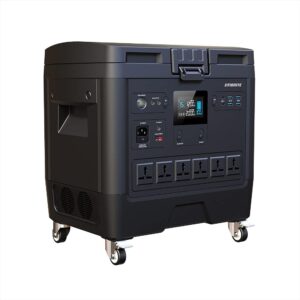

Not all 2kWh power stations are created equal – and when you’re specifically planning to use one for home backup, you’ll want to zero in on features that make your life easier during an outage. Here are the key things to consider:
- Uninterruptible Power Supply (UPS) Functionality: This is a big one for home backup. A UPS feature means the power station can be plugged into the wall and your devices, and it will switch to battery power automatically if the grid goes down. The transfer time matters – look for something around ~10-30 milliseconds or faster to avoid reboots of devices. Many units advertise 20ms or so, which is fine for routers, lights, and most electronics. (Very sensitive gear like servers might need a pure sine UPS with <10ms, but that’s niche). For example, the Jackery Explorer 2000 Plus has an EPS mode with ~20ms switchover. During an outage, a UPS-enabled station keeps your internet, computers, or medical devices running without a flicker – you might not even realize the power died. If you work from home or have critical equipment, UPS capability in your power station is golden.
- Battery Expandability: Some 2kWh stations allow you to attach expansion battery packs to increase capacity. This can be incredibly useful for home backup. Instead of buying an overly large unit up front, you can start with ~2kWh and later add more if needed. For instance, the Bluetti AC200Max lets you plug in extra modules to reach up to ~8kWh, and the Jackery 2000 Plus can chain up to five extra batteries (24kWh max). With an extra battery or two, you could sustain essential loads (fridge, a few lights, Wi-Fi, etc.) for multiple days. Expandability also means a more modular, manageable system – you only hook up the extra battery when you need it, keeping the main unit portable for other times.
- High AC Output and Sufficient Outlets: Check the continuous inverter output – most quality 2kWh units are 1800W to 2400W continuous. 1800W is roughly 15 amps at 120V (standard wall circuit), which is enough for most household appliances individually. Higher output (2000W+) gives more headroom, letting you run a fridge (around 150-200W when compressor is running) plus, say, a microwave or toaster (1000W+) together. Also consider the number and type of outlets: you’ll typically see 3-6 AC outlets. For home use, more outlets = plugging in more devices without power strips. And look for at least one or two high-powered USB-C PD ports (100W) – great for keeping laptops and phones charged without using AC adapters.
- Fast Recharging (and Dual Recharge Options): In a prolonged outage, you may need to recharge the power station (via generator, solar, or when power flickers back on). Units that can recharge quickly are valuable – it’s not just a convenience, it’s a strategic advantage. Some models support dual-input charging: for example, EcoFlow’s Delta series can accept AC + solar simultaneously to charge faster. If you have a home backup generator or solar panels, being able to dump charge in a couple hours is helpful. Also, if you live in an area with frequent brief outages, a fast recharge (and high input wattage) means you can juice it back up in between events. Note: Fast charging is generally okay on these lithium batteries – manufacturers design for it – but some offer an option to charge slower to extend battery lifespan. (Jackery, for instance, defaults its 1000 V2 to ~1.7-hour charge unless you enable “fast mode” for 1-hour charge, to optimize battery health.)
- 240V Compatibility (if Needed): Standard portable power stations output 120V. But if you want to backup 240V household circuits (like well pumps, electric dryers, some HVAC systems), you’ll need a solution. A few brands allow “split-phase” linking of two units to get 240V output. Example: pairing two identical EcoFlow Delta Pros with a special hub can do 240V, or the Jackery 2000 Plus can link two units for 240V/6KW output. This is a more advanced setup – if you don’t absolutely need 240V, you can skip it. But it’s good to know your chosen system’s capabilities in case you plan to integrate with home circuits via a transfer switch.
- Capacity and Output Ratio: For backup, you want a balance – sufficient capacity to last through the average outage, and enough output to run what you deem essential. If an outage is typically 3-5 hours, 2kWh is plenty. If you’re preparing for potentially days (storm scenarios), consider one with expandability or use solar panels to recharge daily. Also, pure sine wave output is a must (almost all quality stations are pure sine, which is clean for electronics).
- Monitoring and Management: Many top models have apps or at least good screens. Being able to see, in real time, how many hours remain at the current load is very helpful during a blackout (lets you ration power intelligently). Some apps allow scheduling or remotely turning AC/DC ports on/off. Not strictly necessary, but a nice modern touch.
- Solar Charging Capability: For home backup in extended outages, solar panels can be a lifesaver. Look at the solar input specs – e.g., “supports up to 500W” or “up to 50V, 15A input”. Higher input means faster solar charging (given enough panels). If you already have solar panels or plan to get some, ensure connector compatibility (many use MC4 connectors). Some power stations come with an adapter cable for MC4 to their input.
- Pass-Through Power: Most power stations allow you to use them while charging. For home backup, you’d likely keep it plugged in (topping up) and have devices connected, essentially using it as a giant UPS. Check that the model supports pass-through on all outputs you need. Fortunately, lithium-ion doesn’t have the memory effect, so using it while plugged in is fine for most units.
- Noise and Placement: Unlike gas generators, battery units are very quiet. But they do have fans that kick in. During high loads or charging, the fan noise can be noticeable (somewhere between a laptop and a desktop PC fan sound). If you’ll keep it in a living space, fan noise level might matter – some models have “quiet mode” charging. For instance, one can reduce charging speed to make fans stay off or low (Jackery’s app offers a lower-noise 30dB charge mode). Also ensure you can place the station in a well-ventilated spot, away from heat sources or open flame (common sense with any lithium battery).
In summary, for a home backup-focused 2kWh power station, look for UPS functionality, fast and flexible recharging, and possibly expandability to grow your backup system. These features together mean your power station isn’t just a one-time use box, but a core part of a resilient home energy setup. When the grid goes down, you want your backup power to kick in immediately, run what you need, and recharge quickly for the next round. The good news: the top models we discussed in the main list tick all these boxes. Pair your choice with a plan (like knowing which appliances you’ll plug in, having some solar panels or a generator for recharging if needed), and you’ll be sitting comfortably during the next outage while your neighbors break out the candles.